
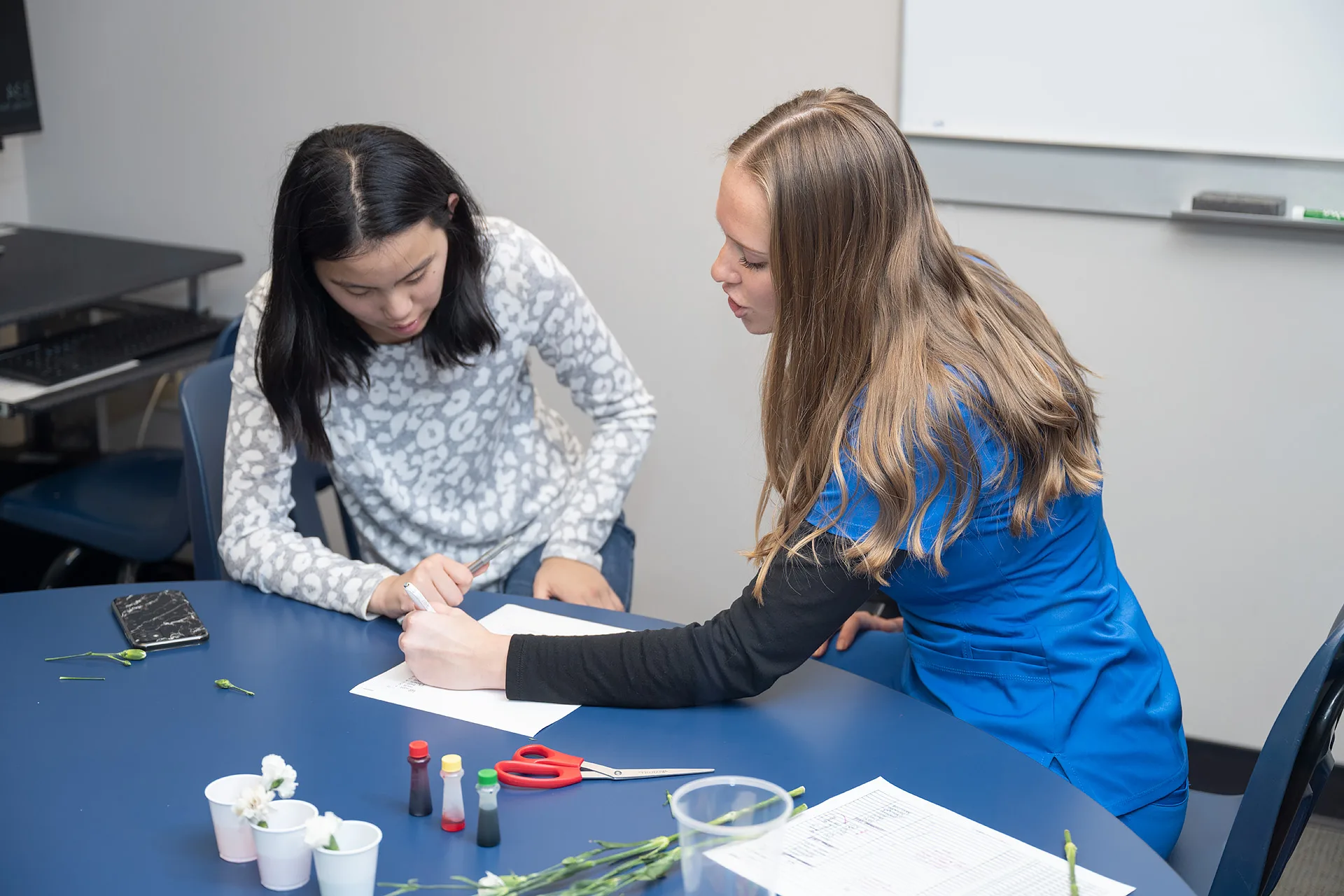
Speech-Language Pathology and Audiology
Provide clinical services in health care and education facilities and serve as consultants in business, industry, and government.
Speech-Language Pathology and Audiology, B.S.
The Bachelor of Science program in Speech-Language Pathology and Audiology is offered in the Department of Health and Human Performance through the College of Health and Behavioral Sciences at MTSU. Whether helping a child who stutters or an adult with a hearing loss, the Speech Language Pathologist and Audiology degree program, formerly Communication Disorders, in the Department of Health and Human Performance offers students the opportunity to learn about human communication; speech, language, and hearing disorders; and intervention methods for children and adults experiencing communication problems.
As a national leader offering an undergraduate pre-professional degree, MTSU's Speech Language Pathologist degree program helps prepare students for graduate study in speech-language pathology and audiology. The Speech-Language Pathology and Audiology major focuses on diagnosis and intervention for those who have speech or hearing problems. It provides a foundation for students who wish to continue study at the graduate level to become certified as speech-language pathologists or audiologists or who wish to pursue other careers related to communication disorders.
Our Speech-Language Pathology and Audiology Program operates the only community clinic where undergraduate students can gain clinical experience.
If you live in one of these states: GA; you may be able to attend MTSU at in-state rates under the Academic Common Market program.





News Briefs
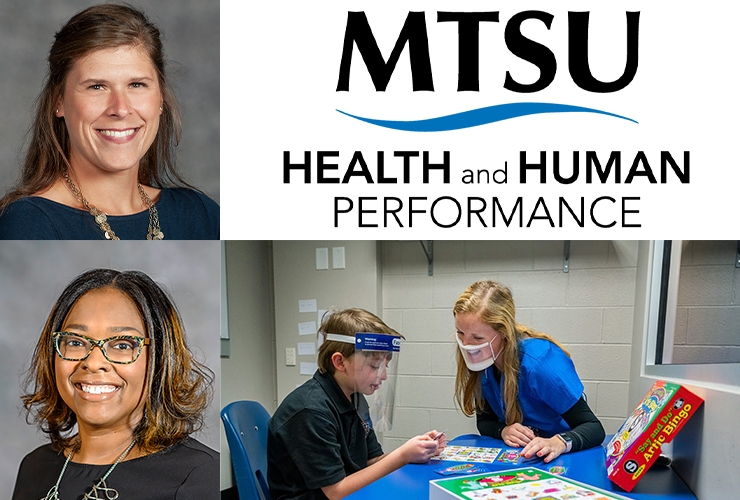
MTSU’s Speech-Language Pathology and Audiology ambassador program uplifts students, receives grants
Two Middle Tennessee State University faculty members in the Department of Health and Human Performance have been recognized with grants to help continue funding their efforts to enhance in- and out-of-classroom opportunities for their students.[ Read More ]
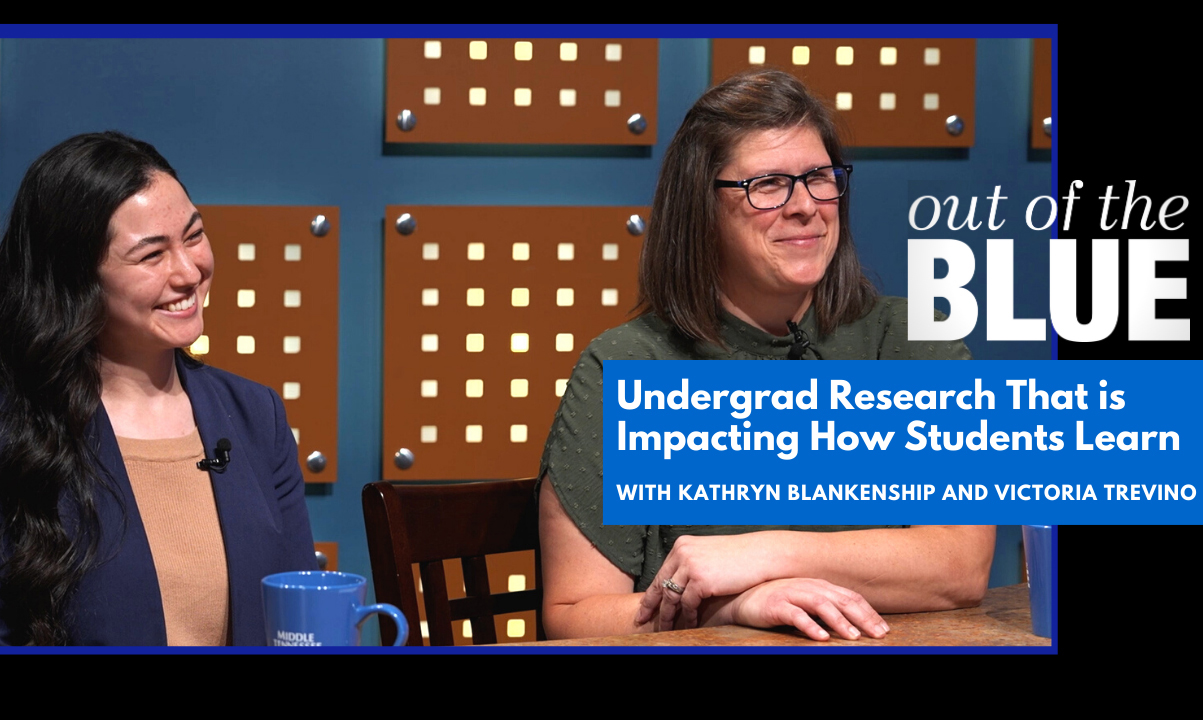
November ‘Out of the Blue’ features speech-language program undergrad research [+VIDEO]
Kathryn Blankenship, Middle Tennessee State University professor in the Speech-Language Pathology and Audiology program, and Victoria Trevino, a program senior who plans to pursue medical school, were guests on this month’s “Out of the Blue” television magazine program to discuss the program and its opportunities for undergraduate research. “We’re one of the few undergraduate-only programs in the [ Read More ]
News Briefs
MTSU’s Speech-Language Pathology and Audiology ambassador program uplifts students, receives grants
Two Middle Tennessee State University faculty members in the Department of Health and Human Performance have been recognized with grants to help continue funding their efforts to enhance in- and out-of-classroom opportunities for their students.[ Read More ]
November ‘Out of the Blue’ features speech-language program undergrad research [+VIDEO]
Kathryn Blankenship, Middle Tennessee State University professor in the Speech-Language Pathology and Audiology program, and Victoria Trevino, a program senior who plans to pursue medical school, were guests on this month’s “Out of the Blue” television magazine program to discuss the program and its opportunities for undergraduate research. “We’re one of the few undergraduate-only programs in the [ Read More ]




Speech-Language Pathology and Audiology, B.S.
Employer List
Alumni Success
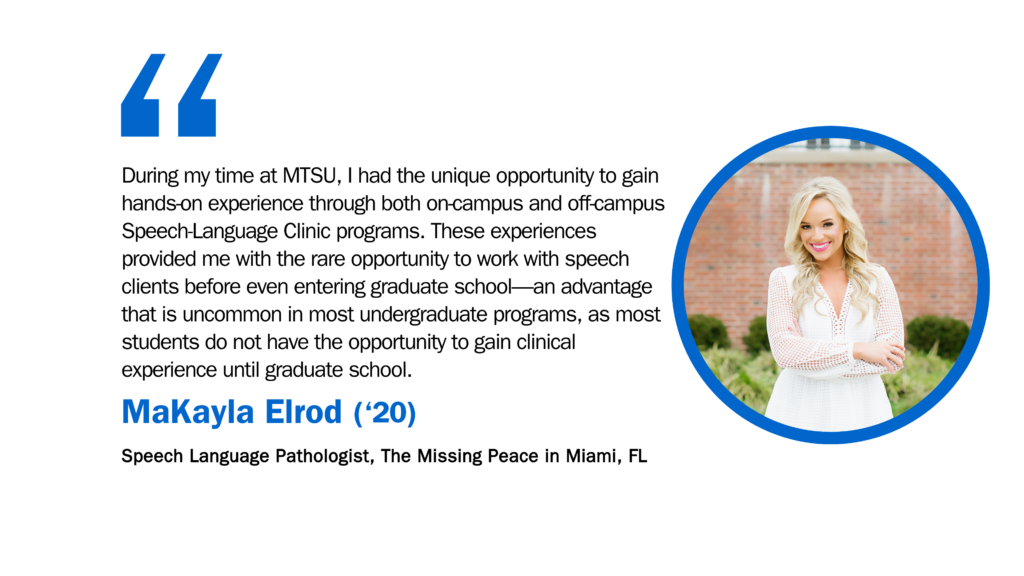
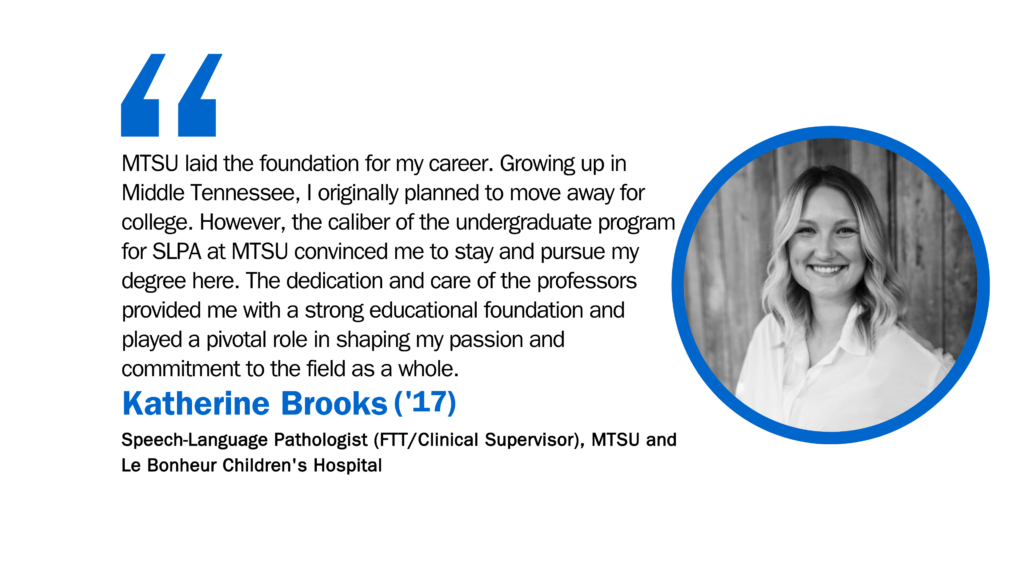
I participated as an intern in the MTSU Speech-Language-Hearing Clinic. It has impacted my career by making me realize I prefer working with the pediatric population. I also participated in several hearing screenings, which made me consider specializing in childhood hearing loss.
-Jason Watkins, Class of '23, Current Graduate Student (M.S. Candidate in Speech Pathology) at Tenneseee State University
The courses I took at MTSU gave me a great foundation. The things I learned helped me to feel well prepared for my master's program, my clinical rotations, and my current career as a travel speech-language pathologist.
-Emmy Davis, Class of '18, Travel Speech-Language Pathologist at Amergis Healthcare Staffing
I believe my degree program prepared me for the challenges that I may face within my career field. My professors and mentors helped create and inform me of situations, both socially and professionally, I may have to face in my life. Through my time working with them at MTSU, I believe I was given the confidence to handle any situation that may be thrown my way.
-Garrick McGee, Class of '23, Speech-Language Pathologist at Arise Therapies
I was able to get clinic experience before working the job. I had practice writing lesson plans, collecting data, and interpreting IEPs, and also gained experience talking to parents and explaining treatment methods. After speaking with other therapists, I have realized how rare it is to have such a comprehensive undergraduate program.
-Ramey Keopf, Class of '23, Speech Language Therapist at Wilson County Schools
I took the Intro to Audiology course and was hooked! I started volunteering with a local group called Bridges in Nashville for the Deaf and Hard of Hearing, read books Dr. Fischer recommended, and craved more information than intro to audiology could give me. I'm forever thankful for Dr. Fischer and her Audiology class for showing me the path that led me to where I am today.
-Hannah Bell, Class of '18, Audiologist at Cabarrus County Schools
Become an SLP-Assistant
Start Your Career in Speech-Language Pathology Sooner. Graduate Ready to Work. With the Speech-Language Pathology Assistant (SLP-A) Program at MTSU.
- Introduction:
- SLP-As work under the supervision of licensed SLPs to deliver direct therapy tasks and assist with documentation and material preparation. This role is vital in schools, clinics, and hospitals.
- MTSU’s Speech-Language-Hearing Clinic has been providing services to the community since 1967. This unique hands-on experience for undergraduate students majoring in speech-language pathology and audiology enables them to graduate with the clinical hours necessary to register as speech-language pathology assistants (SLP-A).
- Why Choose the SLPA Path at MTSU?:
- Graduate Job-Ready: Enter the workforce with a Bachelor of Science degree and the specific training employers are looking for.
- Gain Hands-On Experience: Complete 100 hours of supervised clinical practicum, working directly with clients under the guidance of ASHA-certified SLPs.
- Build a Stronger Grad School Application: This intensive clinical experience makes you a highly competitive candidate for master's degree programs.
- Make an Immediate Impact: Begin helping children and adults with communication disorders right after you graduate.
- Program Requirements:
- 100-Hour Clinical Practicum: Describe the clinical experience. Mention the types of settings available (e.g., MTSU Center for Speech-Language, and Hearing Clinic). Emphasize that all hours are supervised by licensed SLPs.
- Career Outlook: Tennessee has seen a high projected growth in demand for Speech-Language Pathology Assistants (SLP-As). Job growth for SLP-As specifically is also high, with one projection estimating a 21% growth from 2018 to 2028 nationally. You can find this information here: https://www.zippia.com/speech-language-pathology-assistant-jobs/trends. The need for SLP-As is increasing rapidly to support licensed SLPs who face high caseloads and a growing student and patient population with communication and swallowing needs.
- How to Get Started:
- Current students please contact your advisor, to officially declare the SLP-A major.
- Prospective students please indicate your interest on your MTSU application or contact us for more information.
Continuing to Grad School
- Description: MTSU does not offer a graduate program currently. However, Speech-Language Pathology and Audiology both require a graduate degree. In Speech-Language Pathology, that degree is a two-year master’s degree followed by a Clinical Fellowship Year, a year of supervised practice for which the individual is paid. Audiology requires a four-year clinical doctorate program (including the clinical fellowship year). Competition for graduate school is very high right now. To be considered for most graduate programs, students need a minimum of 3.6 overall GPA.
- Students who complete graduate study and earn the American Speech-Language-Hearing Association’s Certificate of Clinical Competence (CCC) primarily become speech-language pathologists, audiologists, or speech-language and hearing scientists. Some students become teachers in schools for deaf students.
- Students graduating within a year participate in our program’s workshop with faculty members to prepare for the graduate school application process. To learn more about composing resumes and letters of intent, completing applications to graduate school, and the proper protocol for requesting reference letters and writing thank-you notes.
Jobs in Related Fields
- Description: Use your degree in education, advocacy, research, and healthcare support. Here are a few examples:
- Rehabilitation Aide/Technician: In hospitals, skilled nursing facilities, or rehabilitation centers, you could assist various therapists (SLPs, physical therapists, occupational therapists) with patient transport, preparing treatment areas, and administrative support.
- Special Education/Paraprofessional: Working as an aide or assistant in a special education classroom, supporting students with communication, or learning disabilities. Understanding of child development, learning disabilities, and communication disorders.
- Early Intervention Provider/Aide: Working with infants and toddlers to promote early language and developmental skills. Expertise in early language acquisition and developmental milestones.
- Research Assistant/Technician: Working at a university or clinical facility on research projects related to communication, language, or developmental disorders. Knowledge of research methods and data collection.
- Patient or Family Advocate: Working in a hospital or clinic to bridge communication between healthcare providers and patients/families. Strong interpersonal and clear communication skills.
- Case Manager/Service Coordinator: Connecting individuals with disabilities or complex medical needs to necessary services.

MTSU’s Career Development Center
MTSU offers a comprehensive Career Development Center that serves students throughout the full student experience and beyond. They collaborate with faculty and staff to equip students with the tools to be marketable to the world of work and continuing education.
Students can schedule an appointment or check online resources and job boards at mtsu.edu/career.
Students can find current internship opportunities by talking to faculty and visiting the University job and internship board called Handshake.
Wondering what you can do with your major? Check out our What Can I Do with A Major In guides.


The Clinic
Transform Lives, Including Your Own
The MTSU Speech-Language-Hearing Clinic
This is where theory becomes practice. Our on-campus clinic provides services to the community while offering you unparalleled, real-world experience. Under the direct supervision of our expert clinical faculty, you will work with real clients, conduct assessments, and implement treatment plans.
A video made by students taking a tour of our Speech Language, and Hearing Clinic:

Speech-Language-Hearing Clinic
The Middle Tennessee State University Speech-Language-Hearing Clinic serves children and adults who have hearing, articulation, language, voice, stuttering, and other communication problems. Client services are provided by undergraduate students under the supervision of our clinical faculty, who are certified by the American Speech-Language Hearing Association (ASHA) in speech-language pathology (CCC-SLP) or audiology (CCC-A), and are licensed by the State of Tennessee. The clinical services offered by the MTSU Clinic are based on the educational needs of the student clinicians completing the Speech-Language Pathology and Audiology major. When selecting cases, the clinical coordinator considers the client’s disability, space availability, sufficient clinical staff, and scheduling policies.
The MTSU Clinic functions within the academic semester calendar. Each semester, clients or parents obtain a parking pass from Parking Services. Services provided by the University Clinic are billed on a sliding scale at the end of each semester. Currently there is a waiting list for therapy in the University Clinic. For further information, please call 615-898-2661.
Client Forms
- Case History Adult Hearing
- Case History Adult Speech
- Children’s Pre-Evaluation Information
- Release of Information
Completed forms should be returned via fax (615-898-2661), email or mail:
Speech-Language-Hearing Clinic
MTSU Box 364
1301 E. Main St.
Murfreesboro, TN 37132
The Clinic Experience
In addition to the academic course work, Speech-Language Pathology and Audiology majors receive instruction in clinical management. Undergraduate programs that offer opportunities for clinical training are unique. Specialized clinic courses and experiences allow majors to combine academic knowledge with actual clinical services.
Student clinicians work in the University Speech-Language-Hearing Clinic (CDIS 4550-4580) under the direct supervision of speech-language pathologists and audiologists certified by the American Speech-Language-Hearing Association. When meeting special requirements, clinicians may also engage in off-campus clinical (CDIS 4600) or school services (CDIS 4650). Through clinical practicum, students earn clock hours to apply toward the total hours required by graduate programs to fulfill national certification standards. The School Speech-Language Teacher license requires completion of CDIS 4650. Clinical materials and equipment are periodically reviewed and updated so that students receive optimal training in diagnostic methods and therapeutic management.
Prior to enrollment in clinical practicum, students must meet academic and professional eligibility criteria established by the faculty and published in the clinic manual. Academic criteria include a minimum overall GPA of 2.6 in 60 credit hours or 3.0 in the last 30 credit hours, a minimal GPA of 2.8 in the major, a minimal grade of C in each prerequisite course, mastery of phonetic features, and competence in speaking and writing. Students who do not receive a grade of B- or higher in both English composition courses (ENGL 1010 and 1020), as well as students who show unacceptable writing skills in academic or clinical course work, will be required to take an additional English writing course.
The University Clinic, located in the Alumni Memorial Gym (basement), serves children and adults who have hearing, articulation, language, voice, stuttering, and other communication problems. The University Clinic functions within the academic semester calendar.
Ambassador Program
Lead the Way for Future Professionals
Student Ambassador Program
Want to share your passion for speech-pathology and audiology? Our ambassadors are student leaders who represent the department at campus events, mentor prospective students, and serve as a vital link between faculty and the student body. Develop your leadership skills, build your professional network, and help shape the future of our program.
NSSLHA
Find Your Community, Build Your Career
National Student Speech Language Hearing Association (NSSLHA)
Your professional network starts now. MTSU's award-winning NSSLHA chapter is your home for connecting with peers, engaging in community service, and accessing exclusive professional development opportunities. From guest speakers to volunteer events and social gatherings, NSSLHA is where you build friendships and lay the groundwork for your future career.
Advising
Map Your Path to a Rewarding Career
CBHS Academic Advising
The College of Behavioral and Health Sciences (CBHS) Advising Center is your resource for clear, reliable information, designed to help you:
- Understand all degree requirements and program options.
- Access campus resources that support your academic goals.
- Build a personalized educational plan for timely graduation.
While our professional advisors provide the framework and expertise, you make the critical choices. We guide you in thinking critically about your path; you own the decisions and the success that follows.
Tours
See Where Theory Becomes Reality
Departmental Tours and Visits
Ready to visualize your future? Our tours offer an up-close look at the MTSU Speech, Language, and Hearing Department. You'll walk through our campus clinic, see our audiology, and research labs, and meet the faculty and students who make our program exceptional. This is your chance to ask questions and discover the resources that will power your professional training. Schedule your visit and step inside your future career: [email protected].
Additional Information

CONTACT US