Admissions

MTSU Wordmark

We are working very hard every day to recruit the best and the brightest students to enroll at MTSU!

True Blue Tour

As the University welcomes students to campus for a successful Fall 2016, the admissions department is already looking forward to Fall 2017. The recruitment staff
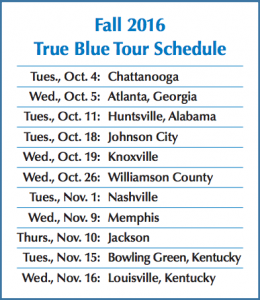
are on the road meeting with students in their communities. The annual True Blue Tour will highlight these fall recruitment activities. This year’s tour boasts 11 stops, an increase from last year, to include a visit to Louisville, Kentucky. University administrators, deans, student services staff, and student leaders, as well as area alumni, will be joining me to welcome prospective students and share information about the admissions process, financial aid, scholarships, and new academic
programs. Students will have the opportunity to learn more about what it means to be
True Blue!2016 True Blue Tour Stops

Tour stops in Georgia, Alabama, and Kentucky will emphasize opportunities for out-of-state students to qualify for in-state tuition rate through participation in the Academic Common Market or the Regional Scholars program. Students who live in participating states and plan to pursue academic majors not offered in their home states, or students whose high schools are in a county within a 250-mile radius of MTSU and achieve qualifying college placement scores can be eligible to receive tuition savings.

Campus Tour Experience

As each academic year begins and we welcome our newest class of students, we also take time to review what worked well for our successful recruitment cycle. Surveys show that the most influential recruitment activity impacting a student’s enrollment decision is the campus visit. Since the start of Fall 2015, more than 15,000 students and guests have come through the admissions campus tour program. That is a remarkable increase of more than 1,000 prospective students and 2,000 additional guests visiting campus compared to the previous year. In order to make the visit more meaningful, the admissions department is enhancing its tour program to create a Tour Experience for each student visiting the University. Upgraded multimedia presentations, along with hands-on exploration,
social media integration, and student-led walk-ing tours, will better enable prospective students and guests to
take a closer look at MTSU.

New Director

meeting-new-director72kb_web
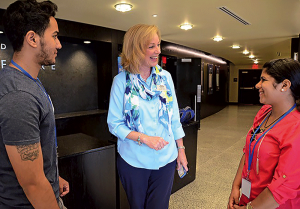
Friends Fady Abdelnour, left, 18, and Mary Sadek, right, 19, both of Nashville and Glencliff High School graduates, visit with Linda Olsen, the new director of undergraduate recruitment at MTSU during CUSTOMS freshman orientation June 1 in Tucker Theatre.

It is my pleasure to “welcome home” Linda Olsen (’98) to serve as the undergraduate director of admissions and recruitment. She brings a background in high school counseling and college admissions and student services administration. Linda comes to MTSU from Eastern Florida State College after serving as director of admissions and advising for the past eight years. A doctoral candidate with the University of Central Florida, she has returned to Tennessee to support the enrollment and student growth of her alma mater. Leading an outstanding team of energetic recruitment staff,
she stands ready to guide students through the admissions process toward
successful degree completion.

Blue Bag Campaign

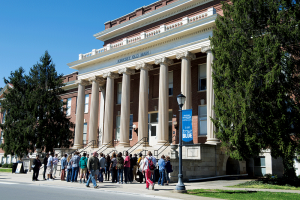
Students have reported feeling welcomed when visiting MTSU. In an effort to expand this sense of belonging, the admissions department is launching the True Blue Bag Campaign. Every campus visitor will be given a distinguishable blue bag upon check-in for their campus tour. With these bags, our campus visitors will be very visible, not only in tour groups, but also as they explore the campus on their own time.

20160307d-040stuoutsidebldg_web


Please take time to greet our guests when you notice the True Blue Bags.  Welcome them to our beautiful campus and share why you are proud to be True Blue.


Fall Preview Days are scheduled for upcoming Saturdays on Sept. 24 and Nov. 5. Each day begins at 8 a.m. in the Student Union Building.

A New Focus

MTSU Wordmark

I wanted to take this opportunity to provide you with several updates regarding MTSU’s work in preparing for the implementation of the recently authorized FOCUS Act by the Tennessee General Assembly and signed by Gov. Bill Haslam. As you know, in December 2015, Gov. Haslam announced the next step in his “Drive to 55” education initiative intended to raise the number of Tennesseans possessing secondary degrees to 55% in order to meet future workforce demands. The six state universities that have historically operated under the auspices of the Tennessee Board of Regents—a group that includes MTSU—were removed from direct control of the TBR. New governing boards specific to each university will now be created or appointed and will have local control over institutional operations such as tuition rates.

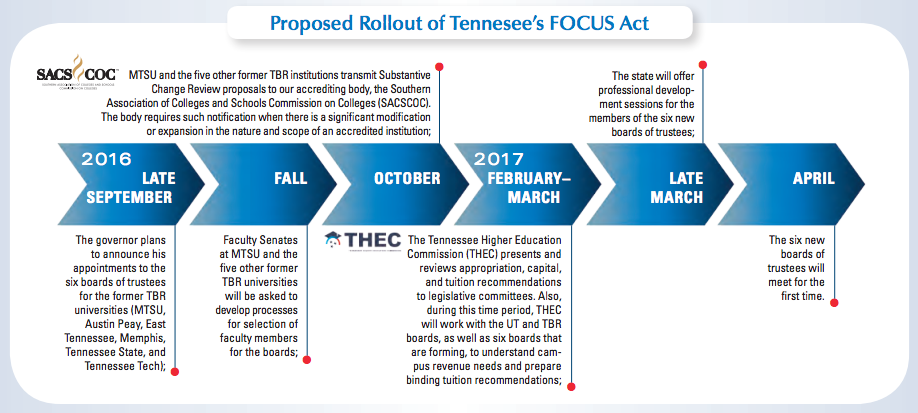
On June 29, I attended an informative meeting of the FOCUS Act Transition Task Force, chaired by the governor, where he presented the timeline for implementation of the new governance structure. Here is a summary:

screen-shot-2016-09-09-at-4-08-40-pm

Late September 2016: The governor plans to announce his appointments to the six boards of trustees for the former TBR universities (MTSU, Austin Peay, East Tennessee, Memphis, Tennessee State, and Tennessee Tech);

Fall 2016: Faculty Senates at MTSU and the five other former TBR universities will be asked to develop processes for selection of faculty members for the boards;

October 2016: MTSU and the five other former TBR institutions transmit Substantive Change Review proposals to our accrediting body, the Southern Association of Colleges and Schools Commission on Colleges (SACSCOC). The body requires such notification when there is a significant modification or expansion in the nature and scope of an accredited institution;

February–March 2017: The Tennessee Higher Education Commission (THEC) presents and reviews appropriation, capital, and tuition recommendations to legislative committees. Also, during this time period, THEC will work with the UT and TBR boards, as well as the six boards that are forming, to understand campus revenue needs and prepare binding tuition recommendations;

Late March 2017: The state will offer professional development sessions for the members of the six new boards of trustees;

April 2017: The six new boards of trustees will meet for the first time.

focus-actcmykkb_web
June 2016 signing of the FOCUS Act

With regards to our internal preparation for the new governance changes, our campus FOCUS Act Implementation Transition Team, divisional working groups, and subcommittees have been busy reviewing MTSU policies and TBR policies and guidelines to determine which ones will be applicable subsequent to the transition to a local board of trustees. As revisions are proposed by the MTSU Transition Team, they will be posted on a new FOCUS Policy web page. As with our current policy review process, policies reviewed by the FOCUS Act Transition Team will be emailed to the campus for review. This began July 15. The normal 30-day comment period will be expanded in order to provide faculty with adequate time for review upon their return to the campus. Thus, any policies put out for review prior to August 26 will have a comment deadline of September 25. Thereafter, it will revert to the standard 30-day period.

Finally, in early June, several MTSU administrators joined me in a meeting with Dr. Russ Deaton, THEC’s acting executive director. I was pleased to review THEC’s priorities during this transition and its commitment to a smooth changeover.

I believe this new proposal advanced by the governor and the corresponding new level of independence for the former TBR universities is truly bold and potentially transformational for MTSU. I look forward to learning and exploring the opportunities it could provide towards our mission of ensuring student success and providing more graduates for the state’s workforce.

Furthering the Quest

Our ultimate success as educators here at MTSU, I believe, lies in our day-by-day efforts to ensure that every student gets the attention they deserve on their path to earning a degree.

Our unwavering focus on helping individual students overcome obstacles, stay enrolled in classes, and earn college degrees, regardless of the external factors around us, is what I believe will make us a successful institution today, tomorrow, and in the future.
MTSU Quest for Student Success

A few years ago, MTSU launched a major initiative—the Quest for Student Success. This Quest is designed to ensure that every student who comes to MTSU with the drive to achieve will be met with the best instruction from excellent professors who care for their success. As part of the Quest, University faculty and staff members have also become more flexible and nimble enough to provide extra support and assistance when our students encounter unexpected difficulties or when roadblocks arise that negatively affect their persistence toward graduation. By doing so, we have created a culture of high expectations coupled with personal attention when students struggle inside or outside the classroom. The following update provides a list of the top 15 recent developments in our Quest. True Blue!

On January 15, 2016, more than 100 students were welcomed to the REBOUND program. In its second year of operation, REBOUND provides specialized advising and programming to freshmen who earn less than a 2.0 GPA in their first semester of studies. The one-year retention rate for students who participate in REBOUND is 50 percent higher than for students who do not.

The Scholars Academy continues its tradition of success in serving at-risk new freshmen. In Fall 2014, 113 students entered the program. By Fall 2015, a total of 85 percent of these Scholars Academy students returned to MTSU, a retention rate that easily surpassed new freshmen who were not a part of the program (73.2 percent). In Fall 2015, the Scholars Academy expanded to serve 167 students. Early indicators show that these students, much like those who participated in earlier programs, continue to excel. About one-quarter were named to the Dean’s List, and nearly 50 percent earned above a 3.0 GPA in their first semester of studies.

MTSU’s tutoring initiative continues to evolve to support the academic needs of students. Although the Office of Student Success coordinates tutoring, the real work involved is accomplished by faculty and chairs who recruit, hire, and manage tutors for their individual program areas. In Fall 2015, free tutoring was offered for 187 courses, representing 24 disciplines. In this semester alone, students spent 7,089 hours in tutoring!

A transformative model of academic advising developed and implemented as part of the Quest has reshaped the student experience at MTSU. This initiative has involved:

  • Selection and appointment of advisor managers for every college
  • Recruitment and appointment of 47 additional advisors to bring the median student-to-advisor caseload to 300/1 or less
  • Creation of work spaces for college advising centers
  • Development of a year-long education and training program to prepare and acclimate advisors to a new student success paradigm
  • Creation and implementation of an advising culture that is student-centered, data-informed, and strategy-driven

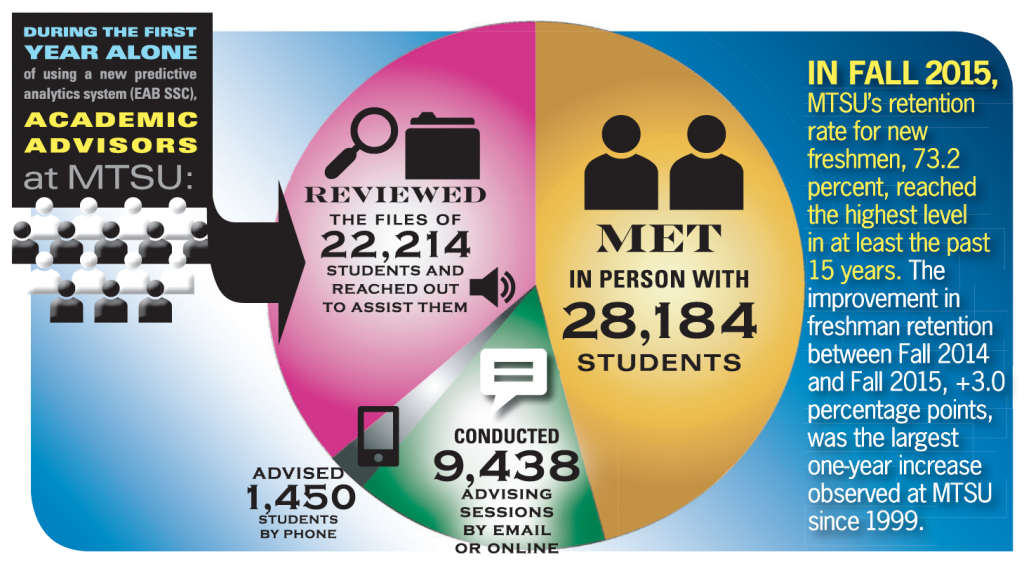
5  During the first year alone of using a new predictive analytics system (EAB SSC), academic advisors at MTSU:

  • Met in person with 28,184 students
  • Conducted 9,438 advising sessions by email or online
  • Advised 1,450 students by phone
  • Reviewed the files of 22,214 students and reached out to assist them
  • Altogether, made 63,945 contacts with students

6  Within the first six months of implementing both this new advising model and the predictive analytics system:

  • MTSU was recognized as a top user among the more than 170 universities using the EAB SSC system.
  • Advisors focused on basic outreach campaigns—like getting students enrolled for the upcoming semester—that produced significant gains in persistence rates from the Fall 2014 to Spring 2015 semester.
  • Persistence rates increased by 2.2 percentage points for new freshmen, 4.5 points for transfers, and 2.1 points for sophomores.
  • It is estimated that improvements in persistence rates for the first semester alone resulted in the generation of an additional $1.5 million in Spring 2015 tuition and fees.
  • It is estimated that these efforts resulted in retaining an additional 390 students from Fall 2014 to Spring 2015.

7  In Spring 2015, more than 2,500 students were surveyed about their experiences with academic advising at MTSU. The results were compared to a survey conducted of the undergraduate population exactly two years prior. Student opinion of advising experiences were significantly higher in 2015 as compared to 2013, especially on items that included:

  • Willingness to discuss problems
  • Responds in a timely manner
  • Is approachable and easy to talk with
  • Is available when assistance is needed
  • Is helpful in clarifying life and career goals
  • Is helpful in obtaining tutorial assistance
  • Is helpful in improving study habits
  • Is helpful in selecting a major

8  During the Spring 2015 semester, advisors managers, chairs, program coordinators, and faculty went through a careful process to identify “success markers” for more than 150 undergraduate programs. This involved a thorough assessment of each program area’s most predictive courses, establishing grade thresholds for these courses, and determining sequences for course completion. Success markers have been entered into and are active in the EAB SSC system. These markers enable the identification of students who are at-risk or off-track in completing degree requirements. Academic advisors use these success markers in conjunction with risk prediction to conduct outreach campaigns to assist students.

9  Over the past three years, a total of 28 MTSU gateway, high-enrolled undergraduate courses have been redesigned. All 10 of MTSU’s most predictive and most enrolled courses have been redesigned. The redesign of courses, in every case, has led to increases in rates of success for students.

10  In Fall 2015, MTSU’s retention rate for new freshmen, 73.2 percent, reached the highest level in at least the past 15 years. The improvement in freshman retention between Fall 2014 and Fall 2015, +3.0 percentage points, was the largest one-year increase observed at MTSU in at least the past 15 years.

11  Although Spring 2016 census data will not be available until later in the semester, trends show that persistence (the percentage of students who started in Fall 2015 and return in Spring 2016) continues to increase—in every category! Although Spring 2015 was a record year for student persistence, trends suggest continued persistence increases across all student categories for Spring 2016.

12  Raider Learning Communities (RLCs) were re-invigorated for the Fall 2015 semester, with 28 paired courses offered to serve students. Pairings of courses were predicated on the analysis of course offerings data from previous semesters. Faculty members were encouraged to consider participating in an RLC. Professional development support including readings and a retreat were provided to RLC faculty. Analysis of student experiences and performance outcomes is underway.

13  In the past six months MTSU has participated in limited-invitation convenings to discuss the future of higher education and student success initiatives, including:

  • In December 2015 in Indianapolis at the invitation of the Lumina Foundation
  • In October 2015 in Indianapolis as a panelist at EDUCAUSE, sponsored by the Bill and Melinda Gates Foundation
  • In September 2015 in Seattle at the invitation of the Bill and Melinda Gates Foundation

14  MTSU has become recognized regionally and nationally by media outlets, national organizations, and other universities for using fundamental best practices to increase student success rates.

  • MTSU was featured in the March 13, 2015 edition of the Chronicle of Higher Education, and MTSU’s efforts were pointed out in the Washington Post on June 14, 2015.
  • In August 2015, MTSU was identified as one of five finalists nationwide for the prestigious and highly competitive 2015 Project Degree Completion Award from the Association of Public and Land Grant Universities (APLU). The award recognizes high-performing institutions for exemplary student success initiatives to improve retention and degree completion.
  • In September 2015, EDUCAUSE announced 24 recipients of iPASS (Integrated Planning and Advising for Student Success) grants. MTSU was selected to receive $225,000 over the next three years to fund a portion of the SSC Campus and DegreeWorks initiatives. Institutions had to be invited in order to make application for the highly competitive grants. And, of course, competition was stringent among those who submitted proposals. With funding provided by the Bill and Melinda Gates Foundation, iPASS grants are intended to promote and enhance the ability of leading institutions to graduate more students.
  • In October 2015, MTSU was presented with the Data Driven Impact Award by the Education Advisory Board, a consulting group specializing in student success. MTSU was one of three universities to receive an award. In MTSU’s case, the award was in recognition of the University’s use of data to inform decisions that improve the success of students.

15  In August 2015, MTSU academic advisors received my Annual Student Success Award. The award included $25,000 in recurring funds to support professional development needs of advisors.

Changing Times

Tennessee Governor Bill HaslamAs most of you are no doubt already aware, Gov. Bill Haslam has proposed sweeping change regarding the governance structure for the six Tennessee Board of Regents (TBR) universities, including MTSU.

The governor wants to remove those universities from under the direct control of the TBR, which has governed them for decades. In TBR’s place, new local governing boards would be fashioned that would have decision-making power over such crucial University operations as tuition rates, program enhancements, presidential appointments, and budget control.

According to Gov. Haslam, this proposed major structural change would be engineered, in part, to better allow the TBR to focus on the state’s community colleges and Colleges of Applied Technology, which have experienced dramatic enrollment increases as a result of the Tennessee Promise scholarship. The Tennessee Promise program offers eligible high school graduates two years of tuition-free community or technical college. (The Promise contributed to a 10-percent surge in first-time freshman enrollment statewide, a key development in Gov. Haslam’s Drive to 55 education initiative to raise the number of Tennesseans possessing postsecondary degrees or certification to 55 percent in order to meet future workforce demands.)

At the time of the writing of this report, there was still much unknown and undecided about the proposed new higher-education landscape that would be created under this new governance structure. The governor had appointed a task force to fine-tune his plan to create individual governing boards for the six affected Tennessee universities, and I was selected (along with the other presidents of universities currently governed by the TBR) to serve on that committee.

This proposed new governing structure, I believe, has great potential to enable MTSU to tackle its present and future challenges in an even more laser-focused manner. It could do so by granting the University both greater local autonomy in its decision making, as well as greater freedom to think entrepreneurially and even outside the box as regards the need for program enhancements and new initiatives. With the work MTSU has already been accomplishing over the past few years, specifically as it relates to attracting more college-ready students (including transfer students) to campus, I am confident that such a truly bold and potentially transformational proposal would lead to an even brighter future for our University. I look forward to learning and exploring the opportunities it could provide towards our mission of ensuring student success and providing even more graduates for the state’s workforce.

Tennessee Board of Regents ChancellorsIn a related matter, John Morgan, chancellor of the Tennessee Board of Regents, announced his plan to retire at the end of January. David Gregory, who had planned to retire in January as TBR’s vice chancellor for administration and facilities development, was named acting chancellor and will serve until a permanent replacement is selected. Morgan, who has served as chancellor of the state’s university and community college system since October 2010 and led the system’s transformation to become more comprehensive and student focused, called the announcement bittersweet and said it was timed to acknowledge the accomplishments achieved by the system’s institutions over the past five years.

Chancellor Morgan’s visionary leadership of the Tennessee Board of Regents helped bring about significant reforms and improvements in our state’s higher education system.

That leadership was demonstrated by his able work to guide TBR’s institutions during implementation of the Complete College Tennessee Act and Governor Haslam’s Drive to 55 initiatives.

As president of MTSU, I have respected and appreciated his counsel and guidance as we secured our $147 million Science Building, one of the top scientific teaching and research facilities in the nation, and put forward our Quest for Student Success, which has transformed how we teach and serve our students.

I have enjoyed working with the chancellor and, on behalf of our students, faculty, and staff, we thank him for his service to our state and system.

Budget Update

MTSU Wordmark

Budget UpdateMTSU remained relatively flat year-over- year in enrollment this fall (.96 percent headcount and 1.98 percent full-time equivalent decrease). This slight decrease equated to an approximate $1.9 million revenue reduction. However, the two previous fall decreases were 4.82 percent and 5.96 percent respectively, so clearly our ramped-up enrollment efforts are working quite well. This slight decrease is even more impressive given that this was the first fall for the Tennessee Promise scholarship and mentoring program, which provides students a last-dollar scholarship, meaning the scholarship will cover tuition and fees not covered by the Pell grant, the HOPE scholarship, or Tennessee Student Assistance Awards funds. My thanks again to everyone on staff who works so hard on enrollment efforts at our University each and every day.
New revenues from tuition increases equated to approximately $5,270,000. Our net increase in state appropriations (outcomes formula adjustment and new funds for outcomes improvement) was $1,247,300. These new funds were allocated to the following:

  • MTSU portion of two percent pool salary increase;
  • faculty promotions;
  • increased cost of software maintenance agreements;
  • utility and operations/maintenance cost increases;
  • scholarships, tuition discounts, employee fee waivers and dependent discounts, and graduate assistant fee waivers;
  • funding for college deans’ requests for continuing improvements on the MTSU Quest for Student Success initiatives; and
  • student tutoring/supplemental instruction and dual enrollment instruction.

Looking toward fiscal year 2016–17, MTSU’s share of the Tennessee Higher Education Commission’s outcomes formula adjustment will be a decrease of $1,021,100. However, THEC voted at its November 2015 meeting to propose new state funding totaling $40.9 million for the higher education formula institutions. MTSU’s share of the proposed new funding will be $3,908,400. Thus, MTSU’s state funding could actually increase by $2,887,300.

The commission also voted to recommend $12.54 million in capital maintenance funds for MTSU projects, which include Peck Hall HVAC, stairwell, and flooring restoration; Saunders Fine Arts HVAC updates; exterior building repairs to several buildings; domestic water-sewer systems updates; building automation system control panel replacements for several buildings; electrical updates; and energy recovery boiler repair. No MTSU capital project was proposed for new capital outlay funding for 2016–17.

THEC’s recommendations have been submitted to the Department of Finance and Administration for consideration in the proposed state budget that Gov. Bill Haslam will be submitting to the state legislature in the coming weeks. At that point, we will have more information regarding our likely 2016–17 state appropriation.

Salary

In September, 2015, the Tennessee Board of Regents took formal action to approve a two percent Cost of Living Adjustment (COLA) across-the-board (ATB) salary increase for MTSU employees. The salary increase was distributed to all unrestricted and restricted regular full-time and part-time benefit eligible employees and participants in the post-retirement service program on the payroll as of June 30, 2015. Each eligible employee received an increase equal to two percent of their June 30, 2015 salary or $750, whichever was greater.

The minimum payment was prorated for part-time employees. Increases for grant employees were part of the salary adjustments, and their increases were charged to the appropriate grant (increases for auxiliary employees were funded from auxiliary revenues). All increases were effective in the October 2015 pay period but included retroactive pay to July 1, 2015. Unfortunately, due to limited funds available, those increases did not apply to adjunct faculty, temporary employees, graduate assistants, or student workers. It is my sincere hope that as resources become available, we will be in a position to address these very important groups of employees.

Please know how much I value each of you and appreciate your good work. I was grateful that we were able again to give some salary increases to our employees.

Construction Update

Numerous campus construction projects are ongoing or were recently completed. Here is a brief update on those recent and current projects.

Davis Science and Wiser-Patten Science

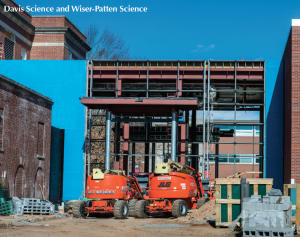
Davis Science and Wiser-Patten RenovationSubstantial completion is planned by late fall for this crucial renovation project, costing approximately $20 million. The new and returning occupants will move in late fall and over the holiday break before the spring 2017 semester. A new connector between the two buildings—the Strobel Lobby—will create a central entrance for both buildings and will provide ADA accessibility within both buildings. The new connector structure is complete, and the exterior skin is being installed.

Wiser-Patten building construction is well underway with finishes beginning. Three-quarters of all mechanical, electrical, and plumbing work is complete in Wiser-Patten, and the new elevators will be installed in February. The lab casework starts this March. Occupants of the buildings will include Physics, Anthropology, and Forensic Science.

Davis Science Building walls are being renovated, and mechanical and plumbing work is about 50 percent complete. Occupants of the buildings will include Academic Advising, Geosciences, and new Mechatronics labs.

Adams Tennis ComplexAdams Tennis Complex
Last summer, the City of Murfreesboro and MTSU officials unveiled the long-anticipated Adams Indoor Tennis Complex, an eight-court facility that greatly enhances the Blue Raider tennis program while increasing playing and tournament opportunities for area residents. The new $6.2 million, 70,000-square foot complex, located at Old Fort Park in Murfreesboro, is the latest partnership between the city, MTSU, and the nonprofit Christy-Houston Foundation.

The complex sports eight indoor tennis courts, two electronic scoreboards, a pro shop, and a lounge area with a mezzanine for spectator viewing. The Murfreesboro Parks and Recreation Department operates the facility, allowing Blue Raider tennis practices and matches to take place from November until March while also providing opportunities for the city to host other tournaments throughout the year.

The new facility gives the Murfreesboro community—including MTSU staff and faculty—more opportunities to watch the Blue Raiders in action without traveling to Nashville.

Middle Tennessee Boulevard Widening

Construction on the widening of Middle Tennessee Boulevard is starting this January following the award of the construction bid to Jarrett Builders Inc., by the City of Murfreesboro. The project is designed to improve traffic flow and safety along the edge of campus, with the introduction of bike paths, additional signalized crossings at Lytle and Division, improved lighting, and landscaped medians and turn lanes in the center.

Traffic calming features are key components to the project to support pedestrian safety in the area. Pedestrian safety is a paramount concern of the project team, and pedestrians crossing the road are encouraged to exercise extreme caution.

Construction will begin on the section south of the culvert at Sinking Creek. Two-way traffic will be maintained at all times throughout the course of the project, planned for approximately 30 months. Entrances to the campus will be maintained at Greenland Drive, Faulkinberry, and Bell Street.

The City of Murfreesboro and MTSU will provide periodic construction status updates and notifications about any changes to the traffic flow or pedestrian crossings.

Livestock Center Parking Lot

Plans are underway to pave and restripe the Livestock Center parking lot and provide improved traffic and shuttle bus circulation, improved lighting, and drainage in the area, as well as a widened pedestrian walk to the lot. Construction is expected to begin this summer.

Miller Education Center Renovation

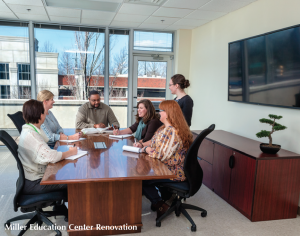
Miller Education RenovationThe renovation of the Miller Education Center (MEC), formerly the Bell Street Center, is complete and is open for the start of spring semester. The center is an approximately two-minute drive from the edge of campus, located located between Greenland Drive and Bell Street at Highland. New occupants include the Jennings A. Jones College of Business Center for Executive Education, the University College, the Center for Counseling and Psychological Services, and the Center for Chinese Music and Culture.

The Chinese cultural center is the result of a $1 million grant provided by Hanban Confucius Institute in Beijing, an organization sponsored by China’s education ministry that oversees more than 440 institutes in 120 countries. In collaboration with our sister university, Hangzhou, the new center will promote music as a vital element in education and understanding of Chinese people and culture. It will also become another component of our extremely successful international outreach, which has earned MTSU recognition as a leader in global studies.

The MEC renovation includes upgrades to a meeting space on the second floor adjacent to the central atrium. The meeting space will accommodate flexible seminars for 60 occupants, or approximately 145 occupants for special events. In addition, there are offices for University Police and Events Coordination. Site improvements include lighting upgrades in the garage, new lighting in the surface parking lots, and new fencing around the green space, now complete.

MT Engage and SACS accreditation

The compliance audit for our reaffirmation of accreditation by the Southern Association of Colleges and Schools Commission on Colleges (SACSCOC) will be submitted in the coming weeks. Importantly, the development of our new Quality Enhancement Plan (QEP), as part of the reaccreditation process, is well underway. A draft of the plan, branded MT Engage—which was announced in the fall of 2014—is available to the campus community on the QEP web site http://www.mtsu.edu/QEP/submission_draft.php.

MT EngageAs part of the ongoing effort to have broad-based involvement into the plan, I invite faculty, staff and administrators to read the plan to provide feedback to the QEP chair, Dianna Rust, or subcommittee chairs, Jason Vance, Lara Daniel and Michelle Boyer-Pennington. The on-site review of the QEP will be March 29-31.

MT Engage seeks to create a culture in which students become actively engaged in their learning. This will be accomplished by supporting faculty who seek to incorporate high-impact engagement pedagogies into their teaching. The second key piece of MT Engage is getting students to reflect and think about their learning. Each MT Engage-designated course will require students to complete at least one assignment that fosters integrative thinking and reflection. Examples of this work will be collected in personalized ePortfolios, which will become showcases for students’ integration of the knowledge, skills, and abilities gained during their time at MTSU.

I would like to thank each member of the MT Engage Development Committee for their efforts to create a successful plan that will enhance student’s satisfaction with their learning and improve student learning outcomes.

Holiday Greetings from Middle Tennessee State University

In this season of gratitude, we are thankful for your friendship and support.

Wishing you and your loved ones peace, health, happiness and prosperity in the coming New Year.

Press play for a special holiday greeting from Middle Tennessee State University.

Sincerely,

Sidney A. McPhee

President

Cost-of-living adjustment for staff

Last Thursday, September 17, 2015, the Tennessee Board of Regents held its quarterly meeting at Jackson State Community College in Jackson, Tennessee.  At that meeting, the Board took formal action to approve a 2% Cost of Living Adjustment (COLA) across-the-board (ATB) salary increase for MTSU employees.

The salary increase will be distributed to all unrestricted and restricted regular full-time and part-time benefit eligible employees and participants in the post-retirement service program on the payroll as of June 30, 2015.  Each eligible employee will receive an increase equal to 2% of their June 30, 2015 salary or $750, whichever is greater.  The minimum payment will be prorated for part-time employees.  Increases for grant employees are part of the salary adjustments and their increases will be charged to the appropriate grant; and increases for auxiliary employees will be funded from auxiliary revenues.  All increases will be effective in the October pay period but will include retroactive pay to July 1, 2015.

Unfortunately, due to limited funds available, these increases will not apply to adjunct faculty, temporary employees, graduate assistants, or student workers.  It is my sincere hope that as resources become available we will be in a position to address these very important groups of employees.

Please know how much I value each of you and appreciate your good work.  I am grateful that we are able again to give some salary increases to our employees.


Panel to study Forrest Hall name

Here’s the announcement we’ve made to the public on the creation of a task force that will give me recommendations on the naming of Forrest Hall. Once the committee is up and running, they will be seeking feedback from all corners of the university community. As you can read in this announcement, I’ve asked them to give me a recommendation by April 2016.

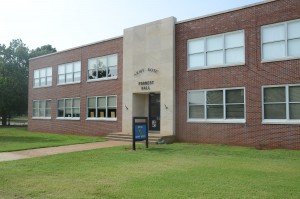
MTSU Forrest Hall exteriorMURFREESBORO — Derek W. Frisby, a distinguished MTSU professor whose research has examined the Civil War and how cultures memorialize military conflict, was appointed Thursday (Aug. 27) to chair a panel to re-examine whether the university should change the name of Forrest Hall.

The university announced in June that it would engage the community on the name of the campus building that houses MTSU’s Army Reserve Officer Training Corps program and is named after Confederate Gen. Nathan Bedford Forrest. The decision came following a mass shooting at a historically black South Carolina church that prompted a national discussion about Confederate iconography on public property.

Forrest, a Confederate officer praised for his tactical methods, has also drawn attention recently because of his early ties to the birth of the Ku Klux Klan. A state of Tennessee historical panel is reviewing whether a bust of Forrest should be removed from the State Capitol.

Frisby, a faculty member in the Global Studies and Cultural Geography program in the College of Liberal Arts, was a 2003 military history fellow at the U.S. Military Academy at West Point. A graduate of MTSU, he has authored numerous articles and essays dealing with Tennessee’s Civil War occupation and serves as a historical consultant to ROTC programs and National Guard units in and near Middle Tennessee.

“I am pleased that Professor Frisby, a scholar of Civil War history and an expert in the field of military commemoration, will lead this panel,” said President Sidney A. McPhee, who announced Frisby’s appointment to a crowd of peaceful protesters during a Thursday rally outside Forrest Hall. “I am confident that he will conduct the panel in a manner that will be inclusive of all viewpoints and perspectives.”

McPhee said the panel will include student, faculty and community representatives. The panel will be tasked to recommend whether the building should be renamed; retain the name but with added historical perspective; or recommend that no action or change is warranted. The Tennessee Board of Regents would have to approve any recommended name change and the university is also researching whether other state authorities would have give approval as well.

Frisby, who served in the Marine Corps, is also involved in various campus initiatives as a member of the MTSU Veterans Memorial Committee, which established a monument plaza near the Tom Jackson Building. He frequently conducts courses in Europe and Asia that explore battlefields and the cultural influence of warfare.

“My research has focused on conflict and culture and how societies remember and memorialize warfare,” Frisby said. “These kind of questions are not unique to America – they happen all over the planet.

“We want to put this not only in an institutional, regional and national context, but a global context as well.”

Forrest Hall was built in 1954 to house the ROTC program, but wasn’t dedicated until 1958, when the name became official. It was chosen because of Forrest’s notoriety as a military tactical genius and his ties to Middle Tennessee, including being born in the region.

Debate about the university’s ties to Forrest rose periodically through the civil rights era and beyond, with the university removing a 600-pound bronze medallion of Forrest from the Keathley University Center in 1989. Opposition to the name of Forrest Hall didn’t reach its height until 2006-07, when a number of students petitioned to have the name removed because of Forrest’s ties to the Ku Klux Klan.

Others supported keeping the name. A series of public forums were held, with the university deciding to keep the name after the Student Government Association rescinded an earlier request to consider a name change and African-American student groups informed university leaders that such a name change was not a priority for them at that time.

Frisby was tasked with researching the institution’s association with Forrest’s image as part of the 2007 discussion on Forrest Hall. His findings were also incorporated into an Honors lecture series and as part of a published collection of essays that marked the university’s centennial in 2011.

Frisby received the 2009 MTSU Outstanding Teaching Award and recently appeared on the National Geographic Channel’s Civil War series, “Civil Warriors,” in an episode that detailed the conditions of Union occupation in the Middle Tennessee region.