
University Policies
404 Financial Conflict of Interest for Externally Funded Projects
Approved by President
Effective Date: August 31, 2026
Responsible Division: Academic Affairs
Responsible Office: Vice Provost for Research
Responsible Officer: Vice Provost for Research
I. Purpose
This policy is predicated on the expectations that investigators will conduct their affairs so as to avoid, mitigate, or minimize conflicts of interest, and they must respond appropriately when conflicts of interest arise in accordance with this policy and with Policy 12 Conflict of Interest. This policy informs Investigators about situations that generate financial conflicts of interest related to research; and provides mechanisms for Investigators and Middle Tennessee State University (MTSU or University) to manage those financial conflicts of interest. Every Investigator has an obligation to become familiar with, and abide by, the provisions of this policy. If a situation raising questions of conflict of interest arises, an Investigator should discuss the situation with the Institutional Official. Investigators must also abide by all applicable University policies including Policy 211 Misconduct in Research and Other Scholarly Activity.
In addition to this policy, the Department of Health and Human Services has promulgated additional regulations related to Investigator financial conflicts of interest that affect institutions applying for and receiving research funding, to ensure that the design, conduct, and reporting of research funded by PHS is free from bias resulting from Investigator financial conflicts of interest. The NSF and PHS require each institution to maintain an appropriate policy to ensure that the financial interests of the individuals planning to participate in or who do participate in federally-funded research do not compromise the objectivity of research supported with public funds. In order to comply with federal mandates and to be consistent in application, this policy shall apply to all externally funded projects.
This policy governing financial conflicts of interest applies to all individuals who meet the definition of Investigator. The Institutional Official is responsible for ensuring implementation of this policy and may suspend all relevant activities until the financial conflict of interest is resolved or other action deemed appropriate by the Institutional Official is implemented. Violation of any part of this policy may also constitute cause for disciplinary or other administrative action pursuant to University policy.
II. Definitions
- Family Member. With regards to the Investigator, their spouse, dependent children, or stepchildren.
- Financial Conflict of Interest. A significant financial interest that the University reasonably determines could directly and significantly affect the design, conduct, or reporting of institutional research.
- Financial Interest. Anything of monetary value, whether or not the value is readily ascertainable.
- Manage. Taking action to address a financial conflict of interest, which can include reducing or eliminating the financial conflict of interest, to ensure, to the extent possible, that the design, conduct, and reporting of research will be free from bias.
- Significant Financial Interest (SFI). A financial interest, foreign or domestic, for the Investigator, or a family member, that reasonably appears to be related to the Investigator’s institutional responsibilities:
- if with a publicly traded entity, the aggregate value of any remuneration (e.g. salary or other payments for services received from the entity) during the twelve (12)-month period preceding the disclosure, and the value of any equity interest during the twelve (12)-month period preceding or as of the date of disclosure, exceeds five thousand dollars ($5,000.00); or
- if with a non-publicly traded entity, the aggregate value of any remuneration (e.g. salary or other payments for services received from the entity) during the twelve (12)-month period preceding the disclosure exceeds five thousand dollars ($5,000.00); or
- if with a non-publicly traded entity, an equity interest of any value held during the twelve (12)-month period preceding or as of the date of disclosure; or
- the receipt of income greater than five thousand dollars ($5,000.00) related to intellectual property rights and interests not reimbursed through the institution, including royalties from such rights and agreements to share in such royalties related to licensed intellectual property rights, during the twelve (12)-month period preceding or as of the date of the disclosure.
- Any reimbursed or sponsored travel valued more than five thousand dollars ($5,000.00) in the preceding twelve (12)months by the investigator and related to their institutional responsibilities is considered a Significant Financial Interest. This includes travel that is paid on behalf of the Investigator rather than reimbursed, even if the exact monetary value is not readily available. It excludes travel reimbursed or sponsored by a federal, state, or local government agency located in the United States, a United States Institution of higher education, an academic teaching hospital, a medical center, or a research institute that is affiliated with a United States Institution of higher education. A Significant Financial Interest does not include the following types of financial interests:
- 1. salary, royalties, or other remuneration from the University, if the Investigator is currently employed or otherwise appointed by the University, including intellectual property rights assigned to the University and agreements to share in royalties related to such rights;
- 2. income from seminars, lectures, or teaching engagements sponsored by or from advisory committees or review panels for a federal, state, or local government agency located in the United States, a United States Institution of higher education, an academic teaching hospital, a medical center, or a research institute that is affiliated with a United States Institution of higher education; or
- 3. equity interests or income from investment vehicles, such as mutual funds and retirement accounts, so long as the Investigator does not directly control the investment decisions made in these vehicles.
- Any reimbursed or sponsored travel valued more than five thousand dollars ($5,000.00) in the preceding twelve (12)months by the investigator and related to their institutional responsibilities is considered a Significant Financial Interest. This includes travel that is paid on behalf of the Investigator rather than reimbursed, even if the exact monetary value is not readily available. It excludes travel reimbursed or sponsored by a federal, state, or local government agency located in the United States, a United States Institution of higher education, an academic teaching hospital, a medical center, or a research institute that is affiliated with a United States Institution of higher education. A Significant Financial Interest does not include the following types of financial interests:
- Institutional Official. An individual within the University who is responsible for the solicitation and review of disclosures of significant financial interests, including those of the Investigator’s family member(s), related to the Investigator’s institutional responsibilities. For the purposes of this policy, the Institutional Officials are designated as the Vice President of Business and Finance for annual disclosures and the Vice Provost (VPR) or designee for ad hoc disclosures.
- Institutional Responsibilities. The investigator’s responsibilities associated with their institutional appointment or position, such as research, teaching, clinical activities, administration, and institutional, internal, and external professional committee service.
- Investigator. The project director or principal investigator and any other person, regardless of title or position, who is responsible for the design, conduct, or reporting of PHS and other sponsored research, or proposals for such funding. This definition is not limited to those titled or budgeted as Investigator on a particular proposal, and may include postdoctoral associates, senior scientists, or graduate students. The definition may also include collaborators or consultants, as appropriate. The Institution will consider the role, rather than the title, of those involved in the research, and the degree of independence in which they work, when determining who is an “Investigator”.
- Public Health Service (PHS). The Public Health Service of the U.S. Department of Health and Human Services, and any components of the PHS to which the authority of the PHS may be delegated. The components of the PHS include, but are not limited to, the Administration for Children and Families, Administration on Aging, Agency for Healthcare Research and Quality, Agency for Toxic Substances and Disease Registry, Centers for Disease Control and Prevention, Federal Occupational Health, Food and Drug Administration, Health Resources and Services Administration, Indian Health Service, National Institutes of Health, and Substance Abuse and Mental Health Services Administration
- Research. A systematic investigation, study, or experiment designed to contribute to generalizable knowledge relating broadly to public health, including behavioral and social sciences research. The term encompasses basic and applied research (i.e., a published article, book, or book chapter) and product development (i.e., a diagnostic test or drug).
III. Disclosure of Significant Financial Interests
All Investigators are required to disclose in writing to the University their significant financial interests, to include any outside financial interests, related to the Investigator’s institutional responsibilities. The significant financial interest disclosure will not be limited to an Investigator’s research responsibilities or their funded research, as this is too narrow in scope and not consistent with the 2011 regulation. The Institutional Official, or designee, is responsible for the distribution, receipt, processing, review, and retention of disclosure forms.
- Disclosures at the time of application. Prior to entering into sponsored projects or applications for sponsored projects, the Investigator must submit to the Institutional Official an ad hoc disclosure of their significant financial interests with the outside entity(s). Disclosures are to be submitted by all Investigators, regardless of whether there is a significant financial interest to disclose. The University will not submit a research proposal unless the Investigator(s) have submitted such ad hoc disclosures.
- Annual Disclosures during the award. All Investigators must disclose their significant financial interests to the University, through the Institutional Official, on an annual basis. All forms should be submitted to the Institutional Official or designee by March 1 for the previous calendar year.
- Ad hoc Disclosures during the award. In addition to annual disclosure, certain situations require ad hoc disclosure. All Investigators must disclose their significant financial interests to the University, through the Institutional Official, within thirty (30) days of their initial appointment or employment. In addition, all Investigators must submit to the Institutional Official an ad hoc disclosure of any new significant financial interest they acquire during the course of the year within thirty (30) days of discovering or acquiring the significant financial interest.
- Travel Disclosure. Investigators must also disclose reimbursed or sponsored travel related to their institutional responsibilities, as defined above in the definition of significant financial interest, prior to travel or after the initial disclosure, within 30 days of each travel occurrence. Such disclosures must include, at a minimum, the purpose of the trip, the identity of the sponsor/organizer, the destination, the duration, and, if known, the monetary value. The Institutional Official will determine if additional information is needed (i.e., the monetary value if not already disclosed) to determine whether the travel constitutes a financial conflict of interest with the Investigator’s research.
IV. Review of Significant Financial Interest Disclosures
The Institutional Official, or designee, is responsible for assessing the relatedness of the disclosed significant financial interest(s) to PHS-funded research and determining when they constitute a financial conflict of interest. The following parameters are used to determine relatedness:
- The significant financial interest could be affected by the PHS-funded research, or
- The significant financial interest is in an entity whose financial interests could be affected by the PHS- funded research.
If the Institutional Official, or designee, determines the significant financial interest is related to the research, the Institutional Official, and/or University’s Conflict of Interest Committee in collaboration with the Offices of Research and Sponsored Programs and Academic Affairs, then determines whether the significant financial interest could directly and significantly affect the design, conduct, or reporting of the research. If a financial conflict of interest exists, the Institutional Official will take action within sixty (60) days to manage the conflict, as appropriate.
In cases where the Institutional Official has a disclosed significant financial interest related to the research under review, or where additional independence is warranted, the Institutional Official will recuse themselves from the review and determination, and an above-designated party will perform the review of relatedness and determination of financial conflict of interest.
The Principal Investigator is responsible for notifying the Institutional Official and Office of Research and Sponsored Programs when new personnel are added to a project or when new financial interests need to be disclosed. When an Investigator who is new to participating in the research project or when an existing Investigator discloses a new significant financial interest, the institution’s designated official(s) will review the disclosure(s), make a determination of financial conflict of interest and develop a management plan within sixty (60) days. The Institutional Official will follow all policy items regarding the determination of significant financial interest, review, and management of a financial conflict of interest, if found.
V. Determination and Management of Significant Financial Interests that Pose a Financial Conflict of Interest
A financial conflict of interest will exist when the Institutional Official determines that the reported significant financial interest is related to the research and could directly and significantly affect the design, conduct, or reporting of PHS-supported research, as well as any other externally funded research. If the Institutional Official determines that a financial conflict of interest can be managed, they must require and approve a written management plan that shall specify the actions that have been, or shall be, taken to manage such financial conflicts of interest. Examples of management plan terms include:
- Public disclosure of the FCOI (e.g., in publications or presentations, to study personnel, to the IRB, IACUC etc).
- For human subjects research, disclosure of the FCOI to participants in the informed consent document
- Appointment of an independent monitor to protect against bias in the design, conduct, and reporting of the research
- Modification of the research plan
- Change of personnel roles or removal from portions of the research
- Reduction or elimination of the financial interest (e.g., divesting equity)
- Severance of the relationships that create the financial conflict(s)
The Institutional Official is responsible for developing a proposed management plan, and the Investigator’s supervisor will be responsible for overseeing the fulfillment of the management plan’s terms. ORSP will review PHS-funded financial conflict of interest management plans annually with the immediate supervisors to ensure ongoing monitoring.
To address complex situations, oversight committees may be established by the Institutional Official to periodically review the ongoing activity, to monitor the conduct of the activity (including use of students and postdoctoral appointees), to ensure open and timely dissemination of the research results, and to otherwise oversee compliance with the management plan.
VI. Public Accessibility
The University will make available, within 5 business days of a written request, information concerning any significant financial interest that meets the following criteria:
- The significant financial interest was disclosed and is still held by the senior/key personnel;
- A determination has been made that the significant financial interest is related to the externally funded research; and
- A determination has been made that the significant financial interest is a financial conflict of interest.
The information to be made available shall include:
- Investigator’s name;
- Investigator’s title and role with respect to the research project;
- Name of the entity in which the Significant Financial Interest is held;
- Nature of the Significant Financial Interest; and
- Approximate dollar value of the Significant Financial Interest (dollar ranges are permissible: $0-$4,999; $5,000-$9,999; $10,000-$19,999; amounts between $20,000-$100,000 by increments of $20,000; amounts above $100,000 by increments of $50,000) or a statement that the interest is one whose value cannot be readily determined through reference to public prices or other reasonable measures of fair market value.
Requests for access to or copies of research records must also comply with Policy 120 Public Records – Inspecting and Copying.
VII. Notification to Funding Agency of Financial Conflict of Interest
The Institutional Official or designee will notify the funding agency of the existence of a financial conflict of interest and the action taken to manage the conflict under the following circumstances:
- Prior to the expenditure of funds;
- Within sixty (60) days of identification for an Investigator who is newly participating in the project;
- Within sixty (60) days for new, or newly identified, financial conflicts of interest for existing Investigators;
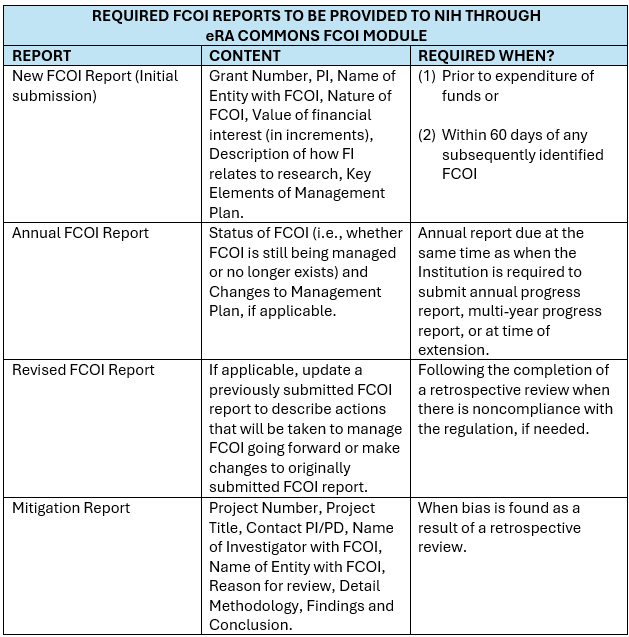
- At least annually (at the same time as when the University is required to submit the annual progress report, multi-year progress report, if applicable, or at time of extension) to provide the status of the financial conflict of interest and any changes to the management plan, if applicable, until the completion of the project; or
- Following a retrospective review where bias is found to update a previously submitted report with a mitigation report, if appropriate. In addition, if bias is not found but new information about the FCOI is discovered that was not previously reported to the NIH, the Institution will submit a Revision to update the FCOI report.
The following table outlines the content of each report that will be made through the eRA Financial Conflict of Interest module:
MTSU will make available to the funding agency, upon request, all identified financial conflicts of interest and the manner in which those interests were managed.
VIII. Financial Conflict of Interest (FCOI) Training
Public Health Services (PHS) requires that all Investigators submitting proposals to PHS complete FCOI training before engaging in research, at least every four (4) years thereafter, and immediately under these prescribed circumstances:
- Institutional Financial Conflict of Interest policies change in a manner that affects Investigator requirements
- An Investigator is new to an Institution
- An Institution finds that an Investigator is not in compliance with the Institution’s Financial Conflict of Interest policy or management plan.
Investigators submitting to other federal agencies will take the FCOI training as required by the agency. Training will inform the Investigator about the federal FCOI regulations and the University FCOI policy, and describe the Investigator’s responsibilities to disclose significant financial interests under the policy.
IX. Non-Compliance
- Institutional Response to Non-compliance. In the event of an Investigator’s failure to comply with this policy, the Institutional Official may suspend all relevant activities until the matter is resolved or other action deemed appropriate by the Institutional Official is implemented. The Investigator may also be subject to disciplinary action due to non-compliance.
The Institution shall promptly notify the PHS Awarding Component of the corrective action taken or to be taken. The PHS Awarding Component will consider the situation and, as necessary, take appropriate action, or refer the matter to the Institution for further action, which may include directions to the Institution on how to maintain appropriate objectivity in the PHS-funded research project.
The action(s) taken by the Institutional Official will be described in a written explanation of the decision and provided to the Investigator, the Provost, and the Investigator’s Dean and Department Chair, and, where applicable, the Institutional Review Board (IRB), and will notify the Investigator of the right to appeal the decision. The Investigator may appeal the decision by submitting, in writing, a request to appeal, listing the reasons for an appeal, within thirty (30) days of receipt of the Institutional Official’s decision. If appealed, the Institutional Official will convene an ad hoc Appeals Committee consisting of the respective Dean and Department Chair, one (1) other faculty member from a department other than the Investigator’s, and the IRB chair, if the project is research involving human subjects, or the IACUC chair, if the project is research involving vertebrate animals. The Appeals Committee will review the appeal and respond within thirty (30) days of the receipt of the appeal. The decision will be sent to the Investigator, the VPR, the Provost, the Dean and the Department Chair. The Provost may determine that disciplinary action is appropriate and, if so, will notify the Institutional Official of the disciplinary steps being taken. - Retrospective Review. Whenever an Institution identifies a significant financial interest that was not disclosed timely by an Investigator or, for whatever reason, was not previously reviewed by the Institution during an ongoing PHS-funded research project (e.g., was not timely reviewed or reported by a subrecipient), the Institutional Official(s) shall, within sixty (60) days: review the significant financial interest; determine whether it is related to PHS-funded research; determine whether a financial conflict of interest exists; and, if so implement, on at least an interim basis, a management plan that shall specify the actions that have been, and will be, taken to manage such financial conflict of interest going forward.
In addition, if the Institutional Official determines that a financial conflict of interest was not identified or managed in a timely manner, a retrospective review shall be completed within one hundred twenty (120) days of the Institutional Official’s determination of noncompliance. This includes, but is not limited to, an Investigator’s failure to disclose a significant financial interest that is determined to be a financial conflict of interest, failure by the Institution to review or manage such a financial conflict of interest, or failure by an Investigator to materially comply with a management plan for a financial conflict of interest.
A committee appointed by the Institutional Official will complete a retrospective review of the Investigator’s activities and the research project to determine whether the research conducted during the period of non-compliance was biased in the design, conduct, or reporting of the research. Documentation of the retrospective review shall include the project number, project title, PI, name of Investigator with the financial conflict of interest, name of the entity with which the Investigator has the financial conflict of interest, reason(s) for the retrospective review, detailed methodology used for the retrospective review, and findings and conclusions of the review. The Institutional Official will update any previously submitted report to the funding agency relating to the research, specifying the actions that will be taken to manage the financial conflict of interest going forward. If bias is found, the report will include a mitigation report in accordance with the PHS regulations, including a description of the impact of the bias on the research project, and the plan of action to eliminate or mitigate the effect of the bias. - Clinical Research Involving Drugs, Medical Devices, or Treatments. If the Department of Health and Human Services determines that a PHS-funded clinical research project, whose purpose is to evaluate the safety or effectiveness of a drug, medical device, or treatment, has been designed, conducted, or reported by an Investigator with a financial conflict of interest that was not managed or reported by the University as required by the regulations, the Institutional Officer shall require the Investigator involved to:
- Disclose the financial conflict of interest in each presentation of the results of the research, or
- Require an addendum to previously published presentations.
The Investigator shall submit documentation confirming that the disclosure of the financial conflict of interest has been made in each presentation of the results. The Institutional Officer will forward the documentation to PHS in an updated report.
X. Subrecipients, Contractors, and Collaborators
Subrecipients, contractors, or collaborators who are working under subagreements from MTSU that are funded by the federal government, must comply with federal regulations (42 CFR Part 50, Subpart F, Grants and 45 CFR Part 94, Contracts).
If the subrecipient’s, contractor’s, or collaborator’s Investigators must comply with the subrecipient’s, contractor’s, or collaborator’s financial conflict of interest policy, the subrecipient, contractor, or collaborator shall certify as part of the written agreement that its policy complies with federal regulation (42 CFR Part 50, Subpart F). If the subrecipient, contractor, or collaborator cannot provide such certification, the agreement shall state that subrecipient, contractor, or collaborator Investigators are subject to MTSU’s financial conflict of interest policy for disclosing significant financial interests that are directly related to the subrecipient’s, contractor’s, or collaborator’s work for MTSU.
The written agreement shall specify time period(s) for the subrecipient, contractor, or collaborator to report all identified financial conflicts of interest to the VPR. Such time period(s) shall be sufficient to enable MTSU to comply timely with its review, management, and reporting obligations.
XI. Maintenance of Records
The Institution will maintain all records of all Investigator financial interest disclosures and the Institution’s review of, and response to, such disclosures (whether or not a disclosure resulted in the Institution’s determination of a financial conflict of interest), and all actions under the Institution’s policy or retrospective review, if applicable, for at least three (3) years from the date the final expenditures report is submitted to the PHS/NIH or, where applicable, from other dates specified in 2 CFR 200.334 for different situations. The Institution will retain records for each competitive segment as provided in the regulation and this Policy.
Copies of Investigator management plans will be retained as part of the Institution’s records and not submitted to the NIH per NIH’s guidance.
In addition, the PHS/NIH Awarding Component and/or HHS may inquire at any time before, during, or after award into any Investigator disclosure of financial interests and the Institution’s review (including any retrospective review) of, and response to, such disclosure, regardless of whether the disclosure resulted in the Institution’s determination of a financial conflict of interest. The Institution will submit, or permit on site review of, all records pertinent to compliance with the regulation and this policy. To the extent permitted by law, HHS will maintain the confidentiality of all records of financial interests. On the basis of its review of records or other information that may be available, the PHS/NIH Awarding Component may decide that a particular financial conflict of interest will bias the objectivity of the PHS/NIH-funded research to such an extent that further corrective action is needed or that the Institution has not managed the financial conflict of interest in accordance with the regulation or this policy. The PHS/NIH Awarding Component may determine that imposition of specific award conditions under 2 CFR 200.208, or suspension of funding or other enforcement action under 2 CFR 200.339 is necessary until the matter is resolved.
XII. Confidentiality
To the extent permitted by law, all disclosure forms, conflict management plans, and related information will be confidential. However, the University may make such information available to an agency funding research of the faculty member; to a requestor of information concerning a financial conflict of interest related to PHS external funding; to the ORI for any NIH related research grant or funding; or to the primary entity who made the funding available to the institution, if requested or required. If the University is requested to provide disclosure forms, conflict management plans, and related information to an outside entity, the Investigator will be informed of this disclosure.
XIII. Regulatory Authority
This policy implements the regulatory requirements of 42 CFR 50 and 45 CFR 94. Where there are substantive differences between this policy and the requirements, the regulatory requirements shall take precedence.
Forms:
Revisions: June 5, 2017 (original); February 18, 2021.
Last Reviewed: August 2026.
References: 59 Fed. Reg. 33242, 33308; 60 Fed. Reg. 35810-35819; 42 CFR 50 and 45 CFR 94; Policies 12 Conflict of Interest; 120 Public Records – Inspecting and Copying; 211 Misconduct in Research and Other Scholarly Activity.