Geosciences
Learn to analyze data and utilize the latest technology to study minerals, soil, fossils, water, and other environmental factors.
Geosciences, Geology Concentration, B.S.
The Geology concentration prepares students to excel in Geology-related careers in public service, the private sector, and education, and for continued studies in graduate school. Job demand for geologists is high with the prevalence of long-term issues such as oil and gas exploration, critical minerals, climate change, water quality, dwindling natural resources, renewable energy, and natural hazard mitigation.
MTSU has one of the Southeast's largest undergraduate Geology programs, but a student-faculty ratio of 15 to 1 allows personal attention and many undergraduate research opportunities.





News Briefs
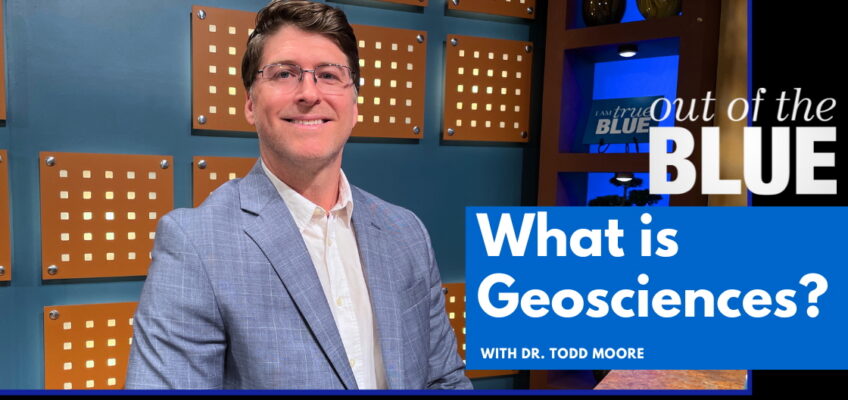
New MTSU Geosciences leader discusses students’ career, research opportunities in April ‘Out of the Blue’ [+VIDEO]
First-year Department of Geosciences Chair Todd Moore discusses cutting-edge technology and how students and faculty are engaging in hands-on research in the study of Earth in the April edition of “Out of the Blue,” Middle Tennessee State University’s television magazine show.[ Read More ]
News Briefs
New MTSU Geosciences leader discusses students’ career, research opportunities in April ‘Out of the Blue’ [+VIDEO]
First-year Department of Geosciences Chair Todd Moore discusses cutting-edge technology and how students and faculty are engaging in hands-on research in the study of Earth in the April edition of “Out of the Blue,” Middle Tennessee State University’s television magazine show.[ Read More ]




Geosciences, Geology Concentration, B.S.
The global demand for geoscientists in areas such as environmental consulting, renewable energy, mining, and the rapidly expanding field of geographic information systems (GIS) far exceeds the current supply.
Graduates often go on to earn master’s and doctoral degrees at some of the nation’s most prestigious research universities or work in geoscience-related professions such as park service, science journalism, and science education.
Career options include working for planning, emergency management, environmental, and conservation agencies at all levels of government as well as military contracting. In industry, many firms including retail chains, financial institutions, insurance companies, and real estate agencies employ geographers to collect and analyze data that relate to the services they provide. A range of NGOs working in areas of the environment, sustainability, and the protection of indigenous ways of life are available too.
Employers of MTSU alumni include
- ARCADIS
- Arnold Air Force Base
- ATC Associates
- Bauer Foundation Corp.
- Chesapeake Energy
- Doe Run Mining
- Esri
- Middle schools and high schools
- Murfreesboro Planning Department
- Notre Dame University
- Nyrstar Mining
- Rutherford County Planning Commission
- Signal Hill Petroleum
- Smyrna Planning Department
- Southwestern Energy
- St. John Engineering
- Tennessee Department of Environment and Conservation
- Tennessee Department of Transportation
- Tennessee State Parks
- Texas Christian University
- U.S. Army Corps of Engineers
- University of Memphis
- University of Oklahoma
- Vanderbilt University
- Wiser Co.

MTSU’s Career Development Center
MTSU offers a comprehensive Career Development Center that serves students throughout the full student experience and beyond. They collaborate with faculty and staff to equip students with the tools to be marketable to the world of work and continuing education.
Students can schedule an appointment or check online resources and job boards at mtsu.edu/career.
Students can find current internship opportunities by talking to faculty and visiting the University job and internship board called Handshake.
Wondering what you can do with your major? Check out our What Can I Do with A Major In guides.


To learn more about the Department of Geosciences, check out our full website!
Professional Licensure Disclosure
MTSU discloses that the Bachelor of Science (BS) in Geosciences, Geology (Earth Science for Teachers) is a teacher licensure preparation program accredited by the Council for the Accreditation of Educator Preparation (CAEP) and approved by the Tennessee Department of Education. Admission to an undergraduate teacher licensure preparation program does not guarantee that students will obtain a teacher license. Successful completion of the meets the educational requirements to apply for a practitioner teacher licensure in Tennessee.
The BS Geosciences, Geology (Earth Science for Teachers) disclosure provided on MTSU’s professional licensure disclosure website indicates the states and territories where MTSU has determined, through reasonable and good faith effort, that the program does or does not meet the educational requirements for other US states and territories. Licensing authorities for each state set and enforce their own requirements and standards, which are subject to change. Current and prospective students not located in Tennessee or who plan to seek licensure or certification outside the state of Tennessee should contact the appropriate state licensing agency or board and discuss their plans with an advisor and the MTSU Office of Teacher Licensure before enrolling in the program to ensure they have the most up-to-date information and guidance regarding licensure requirements.
Environmental and Human Society Minor Requirements
Environment and Human Society Minor
History
Advisor: Lynn Nelson
The interdisciplinary minor in Environment and Human Society helps students who want to explore their relationship with the natural world in ways other than advanced scientific research. Students taking this minor will have the opportunity to look at many different aspects of our attempts to understand and solve environmental problems. Classes are offered in anthropology, biology, English, environmental science and technology, geography, history, journalism, philosophy, and recreation and leisure services. Students considering pursuing a career focusing on environmental matters, those in the sciences hoping to broaden their understanding of environmental issues, or anyone interested in learning more about humanity’s relationship with the environment should consider this minor.
The Environment and Human Society minor requires 18 semester hours from the following courses. Students may not count more than 6 hours in any one department, or more than 6 hours of classes offered through the College of Basic and Applied Sciences. Other specific requirements are explained below.
Interdisciplinary Minors
Interdisciplinary minors require the student to complete a minimum of 15 to 21 hours from a list of specific courses. Unless otherwise noted, a student may take no more than 6 hours of courses from a single department until the required minimum number of hours necessary for completing the minor is surpassed. Exceptions to this rule may be found within the discussions of several of the minors. In most cases, a student is also limited to just 3 hours of credit toward the minor in the same department or discipline as the major. Students must fulfill all departmental prerequisites for any course within an interdisciplinary minor. In some cases, advisors may approve course substitutions within these program requirements.
Required Courses (18 hours)
Select 18 hours from the following:
- ANTH 3310 - Biological Anthropology 3 credit hours
- ANTH 3720 - Environmental Anthropology 3 credit hours
- ANTH 4620 - Environmental Archaeology 3 credit hours
- ENGL 3300 - Native American Literature 3 credit hours
- ENGL 4900 - Selected Topics in Literature and Language 3 credit hours ***
- ENVS 2810 - Introduction to Environmental Science 3 credit hours *
- GEOG 3120 - Geography of Tennessee and the South 3 credit hours **
- GEOG 3410 - Cultures and Landscapes of the United States and Canada 3 credit hours **
- GEOG 3420 - Latin America in the 21st Century: Challenges, New Opportunities 3 credit hours **
- GEOG 3430 - Geographical Approach to Contemporary Europe 3 credit hours **
- GEOG 3440 - Geography of Asia and Pacific Rim 3 credit hours **
- GEOG 3470 - Geography of Sub-Saharan Africa 3 credit hours **
- PGEO 1030 - Physical Geography 4 credit hours
- PGEO 4280 - Special Topics and Problems in Physical Geography 1 to 6 credit hours ***
- GEOG 4340 - Historical Geography 3 credit hours
- GEOG 4500 - Geography of the Middle East and North Africa 3 credit hours **
- GEOG 4540 - Geography of Indigenous Peoples 3 credit hours **
- HIST 3020 - Topics in American History 3 credit hours ***
- HIST 3030 - Topics in African American History 3 credit hours ***
- HIST 3040 - Topics in American Cultural History 3 credit hours ***
- HIST 3070 - Topics in World History 3 credit hours ***
- HIST 4640 - Environmental History 3 credit hours
- JOUR 3520 - Special Topics in Professional Issues 3 credit hours ***
- JOUR 3530 - Feature Writing 3 credit hours ***
- LSTS 4580 - Seminar in Recreation and Tourism Impacts 3 credit hours
- PHIL 4800 - Readings in Philosophy 3 credit hours ***
NOTE:
* Environmental science class; students must complete 3 hours from one of these courses.
** Regional geography class. Students can only count 3 hours toward a minor.
*** Special topics class. Content and projects must meet the mission of the Environment and Human Society minor. Check with the minor advisor for the applicability of each class.


CONTACT US