
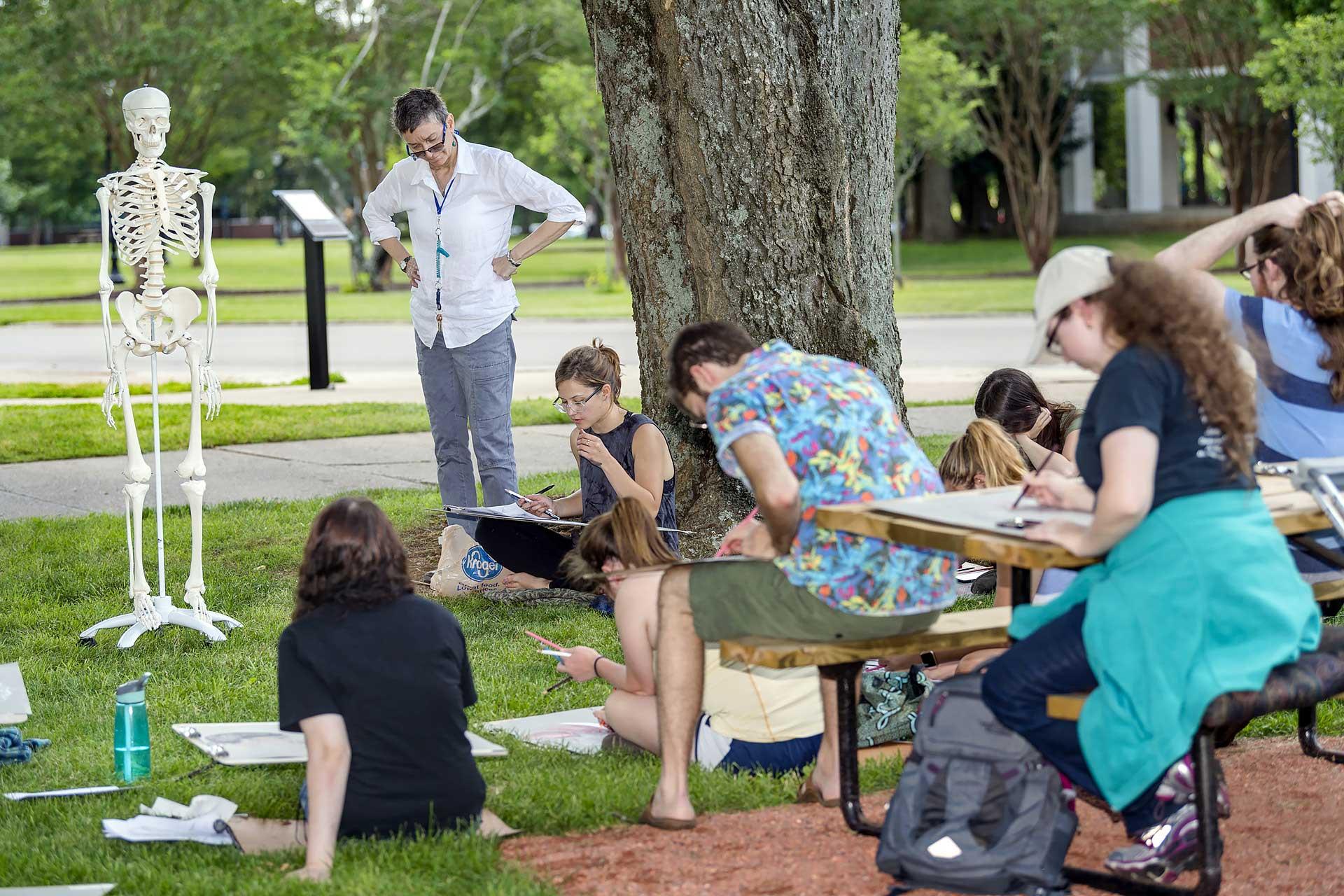
Art
Choose Art History or Visual Arts with ceramics, painting, design, and more for a career in museums, galleries, or grad school.
Art, Visual Arts Concentration, B.S./B.A.
The Bachelor of Arts (B.A.) and Bachelor of Science (B.S.) in Art provide a liberal arts foundation in the visual arts. These degrees emphasize broad exposure, critical inquiry, and contextual understanding rather than intensive professional studio specialization. They are suitable for students interested in fields such as art history, arts administration, art therapy, exhibition design, or art criticism, as well as those planning to pursue graduate studies in related academic disciplines.
Each student completes coursework across a range of visual art areas, including ceramics, painting, printmaking, sculpture, graphic design, and book arts, as well as art history and general education requirements. Faculty members foster critical and creative thinking, supporting the development of visual literacy, clear communication, and problem-solving skills.
These liberal arts degrees differ from the Bachelor of Fine Arts (B.F.A.), which is the professional degree intended for students seeking intensive, advanced studio training in preparation for professional artistic practice or graduate study in a studio art discipline.
Within the B.A./B.S. in Art, students may choose a concentration in Art History or Visual Arts. The Visual Arts concentration emphasizes breadth of studio experience rather than specialization. Graduates may pursue a variety of art-related or interdisciplinary career paths or continue their education in graduate programs aligned with their academic interests.
Frequently Asked Questions
What is Visual Arts?
MTSU offers two degrees, the Art, Visual Arts Concentration, Bachelor of Arts (B.A.) degree and the Art, Visual Arts Concentration, Bachelor of Science (B.S.) degree as part of the MTSU Department of Art and Design’s degree program offerings at MTSU. Both degree programs include the history and theory behind making art and the practice and process of making artwork. Both degrees stipulate that no more than 50 percent of coursework for the degree (60 credits of 120 required) may be completed using courses in the Department of Art and Design. This means that both Art, Visual Arts Concentration degree programs are designed for students seeking a broad, interdisciplinary foundation in art, design, and art history within a liberal arts context. At MTSU, the difference between the Art, Visual Arts Concentration B.A. and B.S. degrees is a language requirement. The B.A. degree requires the completion of 12 hours of World Language credits while the B.S. degree does not.
The MTSU Department of Art and Design recommends that students who want to be a Graphic Designer or Professional Studio Artist pursue the Bachelor of Fine Arts (B.F.A.) Degree in either Graphic Design or Studio Art which are the more rigorous paths of study in those respective fields.
Students should consult with their advisors each semester to plan their course of study.
What are visual arts (as a general term and concept)?
The visual arts, as a general term, help people communicate ideas, tell stories, preserve culture, and express creativity. Art can be found in museums, galleries, public spaces, books, advertisements, and everyday life. Some common types of visual arts include, but are not limited to the following:
- Painting – Creating images with paints on surfaces like canvas or paper.
- Drawing – Making pictures using pencils, pens, charcoal, or other tools.
- Sculpture – Creating three-dimensional artworks from materials like stone, wood, metal, or clay.
- Printmaking – Producing artworks by transferring ink from a prepared surface to paper.
- Ceramics and pottery – Shaping and decorating clay into artistic objects.
- Digital art – Creating art using computers, tablets, or digital software.
Is a portfolio required for Visual Arts?
No, as of 2026, a portfolio is not required to enter the Art, Visual Arts Concentration B.A. or B.S. degree paths at MTSU. A portfolio/application is required for candidacy in our Bachelor of Fine Arts (B.F.A.) programs. Contact the Department of Art and Design or Studio Art or Graphic Design Coordinators for more information on that process.
What skills do you learn in a visual arts program?
- Foundational Skills in Art (Drawing/Observation, Two-Dimensional Design/Composition, Three-Dimensional Design/Constructing, Digital Foundations/Digital Skills)
- Studio Art / Making Skills in both two-dimensional (painting, drawing, printmaking, etc.) and three-dimensional (sculpture, ceramics, etc.) medias
- Art History (survey courses and focused topics)
- True Blue Core Skills (These are the core classes required of all MTSU graduates.)
- Elective Courses: (These experiences can be tailored to individual student interests and must come from outside of the Department of Art and Design.)
- World Language courses, if pursuing the Art, Visual Arts Concentration, B.A.
What jobs can you get with a Visual Arts concentration?
Both Art, Visual Arts Concentration B.A. and B.S. degree programs are designed for students seeking a broad, interdisciplinary foundation in art, design, and art history within a liberal arts context. We recommend that students who want to be a Graphic Designer or Professional Studio Artist pursue the Bachelor of Fine Arts (B.F.A.) Degree in either Graphic Design or Studio Art which are the more rigorous paths of study for those respective fields.
MTSU has a Career Development Center, which is a resource available to assist current students and alumni with career advice, assembling competitive employment packets, and interviewing among many other services. Possible careers in the creative field include:
- Advertising
- Animation
- Appraisal
- Architecture
- Art teacher
- Art therapy
- Artist
- Art conservation/preservation/restoration
- Art criticism
- Art dealing
- Arts management
- Arts administration
- Auctioneering /collecting
- Collections management
- Communications specialist
- Creative technologist
- Curation
- Digital media specialist
- Exhibit design
- Fashion illustration
- Filmmaking
- Gallery professional
- Game designing
- Historical research
- Librarianship
- Museum educator
- Marketing
- Nonprofit work
The Art, Visual Arts Concentration B.A. and B.S. degree programs can be used as the first step toward further education in fields such as:
- Museum Studies
- Arts Administration
- Historic Preservation
- Library and Information Science
- Business (especially Marketing, Communications, or Entrepreneurship)
Is a visual arts degree "worth it"?
Any degree is “worth it” if you make it “worth it” by investing the time and thought into the program. Learning skills and gaining practical experience both within and outside of the classroom are critical to success. Your application/portfolio, internships, networking, and practical experience and/or how you frame your skills and experiences are usually the biggest factors in landing jobs. The broad general educational experience that this degree involves makes it more flexible and applicable to a wider variety of careers.
The Art, Visual Arts Concentration B.A. or B.S. degrees are worth pursuing if you are interested in incorporating visual arts and related skills into your future career. A visual arts education provides a wide range of transferable skills that employers are looking for. The trick is to frame arts-related experiences (studio courses, exhibitions, group projects, critiques, technical media skills, teaching, etc.) in terms of skills employers seek, such as:
- Project Management
- Creativity, Problem-Solving, Innovation
- Collaboration and Teamwork
- Technical Proficiency
- Written, Verbal and especially Visual Communication
- Attention to Detail and Problem Solving
- Adaptability and Resilience
Which degree should I choose: The B.F.A., B.A., or B.S. degrees in Art/Design?
Choose the B.F.A. in Graphic Design if your primary goal is to become a professional Graphic Designer and spend most of your time working in the design field, and/or if you plan to apply to competitive MFA programs. The B.F.A. degree is considered the more rigorous path of study in the respective fields.
Choose the B.F.A. in Studio Art if your primary goal is to become a Professional Studio Artist and spend most of your time working in fine arts, and/or if you plan to apply to competitive M.F.A. programs. The B.F.A. degree is considered the more rigorous path of study in the respective fields.
Choose the B.A. in Art, Visual Arts Concentration if you want a broad college education that includes the study of a world language, and plan to combine art with another discipline, or are considering careers in education, museums, communications, digital media, design technology, multimedia or if you are interested in incorporating visual arts and related skills into your future career.
Both the B.A. and B.S. degree programs include the history and theory behind making art and the practice and process of making artwork. Both degrees stipulate that no more than 50 percent of coursework for the degree (60 credits of 120 required) may be completed using courses in the Department of Art and Design. This means that both Art, Visual Arts Concentration degree programs are designed for students seeking a broad educational experience. While not the case at MTSU, in other places, the B.A. degree is more often associated with liberal arts coursework and is more suited for careers in museums, education, communications, and interdisciplinary creative fields.
Choose the B.S. in Art, Visual Arts Concentration if you want a broad college education, and plan to combine art with another discipline, or are considering careers in education, museums, communications, digital media, design technology, multimedia or if you are interested in incorporating visual arts and related skills into your future career.
Both the B.A. and B.S. degree programs include the history and theory behind making art and the practice and process of making artwork. Both degrees stipulate that no more than 50 percent of coursework for the degree (60 credits of 120 required) may be completed using courses in the Department of Art and Design. This means that both Art, Visual Arts Concentration degree programs are designed for students seeking a broad educational experience. While not the case at MTSU, in other places, the B.S. degree is more often associated with technical or specialized coursework, which can be advantageous for careers in digital media, design, multimedia, or technology-related creative work.





News Briefs
Could not retrieve news articles.
News Briefs
Could not retrieve news articles.
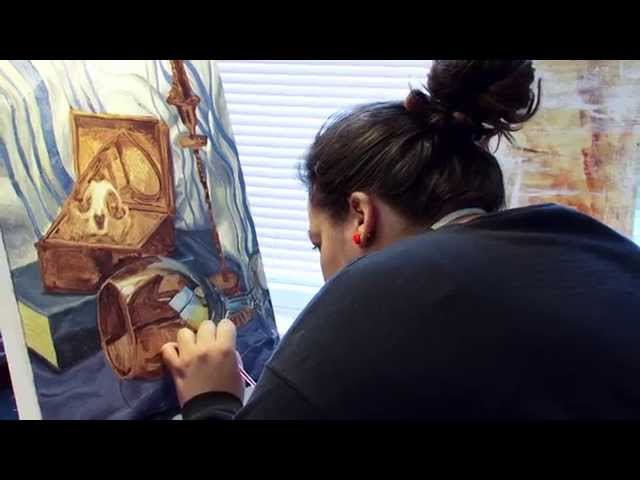




Art, Visual Arts Concentration, B.S./B.A.
Students studying Visual Arts may pursue careers as visual artists or may consider a variety of occupations, including art therapy, arts administration, exhibition design, or art criticism. Examples of fields include, but are not limited to, the following:
- Advertising
- Animation
- Appraisal
- Architecture
- Art teacher
- Art therapy
- Artist
- Art conservation/preservation / restoration
- Art criticism
- Art dealing
- Arts management
- Arts administration
- Auctioneering /collecting
- Curation
- Exhibit design
- Fashion illustration
- Filmmaking
- Game designing
- Historical research
- Librarianship
Employers of MTSU alumni:
Art graduates find professional opportunities at a variety of entities; some individuals choose to continue their studies in graduate school. Examples of both are listed below:
- Academy Street Studio
- Aradani Studios
- CapTeeVation
- Contemporary Painters
- Cumberland Gallery
- For Art’s Sake Studios
- Frist Center for the Visual Arts
- Grand Adventure Comics
- Moxie Art Supply
- Rosewalker Design
Graduate schools
- Pratt Institute
- Savannah College of Art and Design
- California College of the Arts
- Memphis College of Art
- University of Connecticut
- University of Iowa

MTSU’s Career Development Center
MTSU offers a comprehensive Career Development Center that serves students throughout the full student experience and beyond. They collaborate with faculty and staff to equip students with the tools to be marketable to the world of work and continuing education.
Students can schedule an appointment or check online resources and job boards at mtsu.edu/career.
Students can find current internship opportunities by talking to faculty and visiting the University job and internship board called Handshake.
Wondering what you can do with your major? Check out our What Can I Do with A Major In guides.


Public Accountability Notice
MTSU is an accredited institutional member of NASAD, National Association of Schools of Art and Design.
To see data about the program, please visit this webpage: https://planeffectiveness.mtsu.edu/art_bfa/.


CONTACT US