Accreditation
Frequently Asked Questions
Institutional accreditation validates the quality of the university as a whole and assures stakeholders and the public that MTSU has:
- a mission appropriate to higher education
- resources, programs, and services appropriate for the mission
- clearly stated objectives appropriate for its programs
- success in achieving its objectives
These requirements are evaluated through rigorous internal and external peer review processes during which multiple aspects of the university, including its academic offerings, governance and administration, mission, finances, and resources, are evaluated against a common set of standards.
MTSU’s accreditation by an agency recognized by the U.S. Department of Education enables our students to transfer credit to other institutions and to seek federal financial aid funds.
In July 2020, the U.S. Department of Education (USDE) redefined the categories that it recognizes:
- Institutional accrediting bodies conduct comprehensive reviews of institutions of higher education. The accreditation granted encompasses the entire institution, including reported branch campuses, other instructional sites, online programs, and distance learning modalities. Such accrediting bodies typically accredit a wide range of institutions offering associate, baccalaureate, master’s, and/or doctoral degrees.
- Programmatic, or Specialized, accrediting bodies conduct focused reviews of a single educational program and operate primarily throughout the United States, although a few operate internationally.
MTSU’s institutional accreditor is the Southern Association of Colleges and Schools Commission on Colleges (SACSCOC). The University also has many programs with programmatic accreditation.
SACSCOC is the common acronym for The Southern Association of Colleges and Schools Commission on Colleges, an institutional accreditor for quality assurance in higher education. SACSCOC accredits institutions that award associate, baccalaureate, master’s, or doctoral degrees, including those offered via distance and correspondence education, and direct assessment within these institutions. It serves as the common denominator of shared values and practices among its members in the United States and international institutions of higher education approved by the SACSCOC Executive Council, Board of Trustees, and the Appeals Committee of the College Delegate Assembly.
To gain or maintain accreditation, the university must comply with SACSCOC policies, guidelines, and procedures, and with all 73 core requirements and standards contained in the Principles of Accreditation: Foundations for Quality Enhancement. MTSU’s compliance with the requirements is evaluated and determined by peer reviewers in their professional judgment. SACSCOC’s institutional accreditation includes all degree levels regardless of location or mode of instruction.
SACSCOC accreditation must be reaffirmed every 10 years, with an interim report due in year five. MTSU’s accreditation was last reaffirmed in 2016, and our next decennial is in 2026.
Differentiated Review is a streamlined reaffirmation process for SACSCOC institutions in good standing. The process permits MTSU to document compliance with fewer Core Requirements and Standards from The Principles of Accreditation in the initial Compliance Certification. However, the Commission still requires the same reaffirmation components included in the regular process: Compliance Certification, Off-Site Review, Focused Report, On-Site Review, and Commission Review. For detailed information about the standards included in Differentiated Review, visit MTSU’s Reaffirmation of Accreditation homepage and the SACSCOC Differentiated Review Process Policy Statement.
In the Compliance Certification, MTSU explains and documents compliance with each of the 73 SACSCOC Principles of Accreditation Core Requirements and Standards. Institutions approved for the Differentiated Review Process submit a modified Compliance Certification addressing 40 standards.
In the fall of the reaffirmation year, MTSU’s Compliance Certification Report is reviewed by an Off-Site Reaffirmation Committee, composed of evaluators from SACSCOC peer institutions outside Tennessee. At the conclusion of the review, the Committee prepares a report explaining its findings of the university’s compliance with each Core Requirement and Standard. The Committee’s report is also provided to the On-Site Reaffirmation Committee, which travels to MTSU in the spring of the reaffirmation year.
Upon receipt of the Off-Site Review Committee’s report, MTSU may submit a Focused Report addressing the preliminary findings and providing additional discussion and documentation of its case for compliance. The Focused Report must be submitted six weeks prior to the On-Site Reaffirmation Review for evaluation by the On-Site Reaffirmation Committee.
An Institution that does not demonstrate compliance with accreditation standards may be asked for monitoring reports, placed on the public sanctions of “Warning”, “Probation” or “Probation Good Cause,” or dropped from status as a candidate or an accredited institution.
SACSCOC Reaffirmation Links
SACSCOC Reaffirmation Home
On-Site Review
Standards Showcase
Frequently Asked Questions
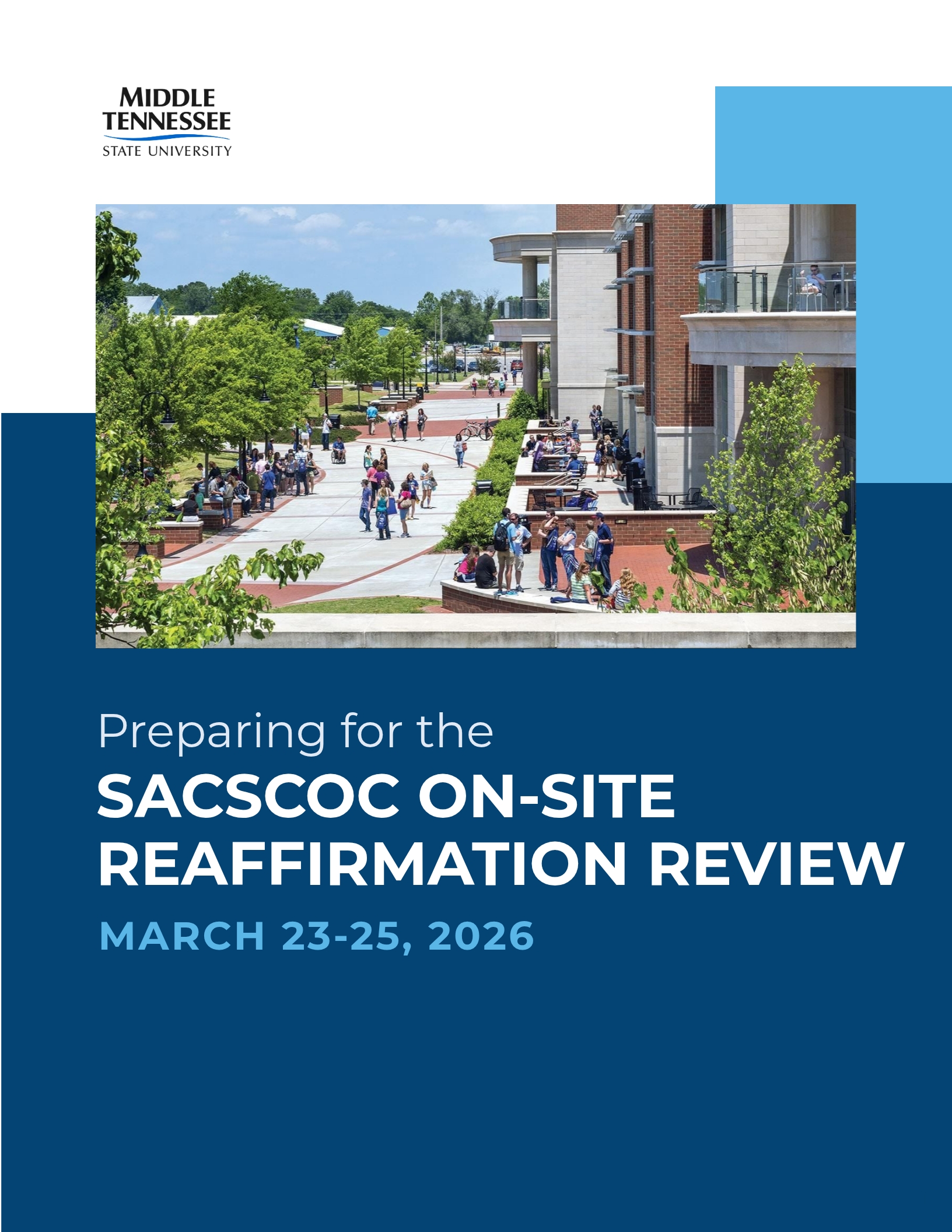
MTSU 2026 On-Site Reaffirmation Guide (Flipbook Version)
MTSU 2026 On-Site Reaffirmation Guide (Downloadable Version)
Related Links
2035 Strategic Plan
MTSU Mission Approved March 2024
Office of Planning and Effectiveness
Institutional Effectiveness, Planning, and Research
Office of the Provost
Tennessee Accreditation Network
Council for Higher Education Accreditation
US Department of Education Accreditation
Contact Us